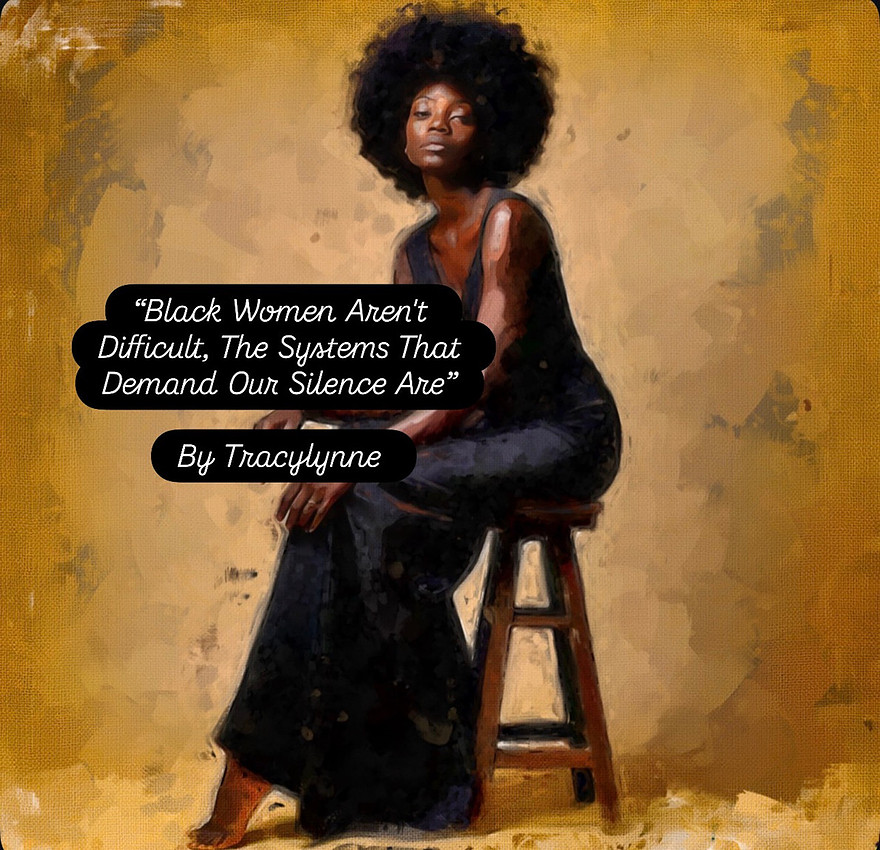
Black Women Aren't Difficult, The Systems That Demand Our Silence Are


Black women are routinely labeled difficult, intimidating, aggressive, or some polished corporate synonym when we do one very ordinary thing: set basic standards. Not extravagant demands. Not special treatment. Standards so mundane they barely register when anyone else asserts them. Pay me on time. Speak to me with respect.
Do not waste my labor, body, or intellect. Somehow these requests are treated as character defects when they come from Black women. This is not opinion. It is a pattern with a paper trail.
Let’s start with the foundational lie: the myth of the submissive feminine ideal. Historically, in the colonial American construct, true womanhood was reserved for white women, cloaked in piety, purity, and fragility. This was a class project. Black women, systematically excluded from this protection, were legally and socially classified as property. Their bodies were not their own.
Their labor, both physical and reproductive, was commodified. Resistance to that condition, whether through sabotage or poisoning enslavers, was framed as savagery rather than a legitimate claim to dignity. It was recorded as disobedience, insolence, a “difficult” piece of property. The label was born not from her character, but from her refusal to be broken. This is your origin story.
Fast forward to Emancipation. The narrative had to shift. The “Jezebel” caricature was deployed to justify sexual violence. The “Mammy” figure was created to depict a contented, subservient caregiver devoid of personal needs or authority. And when Black women inevitably defied these narrow, racist scripts?
When a Ida B. Wells meticulously documented and railed against lynching in the 1890s, she wasn’t celebrated as a courageous investigative journalist. She was run out of Memphis, called troublesome, a troublemaker, for stating the bloody obvious. She set a standard for truth and was met with a campaign of character assassination.
After emancipation, those ideas did not disappear. They were repackaged as social science. In 1965, the Moynihan Report blamed Black women for structural poverty by portraying us as domineering matriarchs who destabilized Black families.
The report ignored segregation, job discrimination, redlining, and mass incarceration. Instead, it pathologized Black women’s strength. That framing still echoes today every time a Black woman is called “too much” for expecting competence, consistency, or accountability.
Now, bring this into the 20th century workplace. The “first and only” syndrome. A Black woman enters a corporate space historically designed without her in mind. She is competent. She is prepared. She expects her credentials to speak. But the cognitive dissonance is real for those wedded to the old hierarchy.
Dr. Shirley Chisholm, the first Black woman elected to Congress, said it bluntly in 1969: “If they don’t give you a seat at the table, bring a folding chair.” Her entire political career was a masterclass in being called difficult for demanding a basic standard of representation. She was told to wait her turn, to be quiet, to not make waves. Her refusal was painted as aggression, not principle.
This isn’t ancient history. A 2019 study published in the Harvard Business Review quantified this. It found that while “executive presence” is a key factor in promotions, its criteria are often culturally biased. White women are advised to “speak up,” while Black women are told to “pipe down.” The same assertive communication labeled “leadership” in a white male peer is labeled “authoritarian” or “angry” when it comes from a Black woman. This is not perception. This is data. It is the modern “insolence” charge.
Consider the mundane scenarios. A Black woman project manager clarifies a timeline. A Black woman professor upholds a plagiarism policy. A Black woman doctor insists on a second test. In a just world, this is professionalism. In ours, it is a risk. She is navigating what psychologist Dr. Jennifer L. Eberhardt calls “biasing spaces,” environments where people’s unconscious biases are triggered by her mere presence.
Her standard is a mirror, and some people do not like what it forces them to see about their own preparedness, their own casual bigotry, their own mediocrity. The label “intimidating” is a projection. It translates to: “Your competence and unwillingness to perform deference makes me uncomfortable.”
The mechanism is theft. It steals credit, it steals peace, it steals advancement. It pathologizes sanity. When you are in a room where the logic is unsound, where the plan is flawed, and you say so with clarity, you become the problem to be managed, not the asset providing a solution. This is the bitter heirloom: the expectation of gratitude for mere inclusion, paired with punishment for expecting equity.
Now consider Serena Williams. One of the most decorated athletes in history. Her on court protests of unfair calls have repeatedly been framed as aggression, while White male players who smash rackets and scream at officials are described as passionate or competitive. This double standard has been documented across sports journalism and broadcast commentary. Excellence did not shield her. It sharpened the scrutiny.
Consider Simone Biles.
The most decorated gymnast in history withdrew from Olympic events in Tokyo after publicly stating concerns about mental focus and physical safety. Her decision was framed by critics as weakness, selfishness, or letting the team down. Male athletes who step away for mental health or injury management are routinely described as strategic, disciplined, or prioritizing longevity.
Biles did not yell, insult anyone, or break protocol. She set a safety standard for herself. The backlash revealed how Black women are punished for refusing to sacrifice their bodies on demand.
Consider Michelle Obama.
Throughout her tenure as First Lady, she was repeatedly described by media commentators as intimidating, angry, or unapproachable, often in response to nothing more than a serious facial expression or direct speech. Comparable images of white First Ladies were described as poised or authoritative.
Academic media analysis documented that Michelle Obama was more likely to be framed through emotionalized and racialized language, even while promoting widely popular initiatives like childhood nutrition and military family support. Professionalism was recoded as menace.
Consider Oprah Winfrey.
As a media executive, Oprah has spoken openly about being labeled difficult early in her career for insisting on editorial control, ethical standards, and ownership. Male media executives who demanded the same authority were described as visionary or tough negotiators. Her insistence on standards was not seen as leadership until her success became undeniable. Even then, her assertiveness was often framed as exceptional rather than expected, as if competence itself required justification.
Consider Maxine Waters.
Congresswoman Waters is regularly characterized as angry or aggressive in mainstream political coverage, particularly when questioning corporate executives or government officials. Her questioning style is direct, structured, and fact driven. Male lawmakers who interrupt, shout, or posture physically are framed as forceful or passionate. Media studies of congressional coverage show that Black women legislators are far more likely to have their tone criticized than the substance of their questions addressed.
Consider Gabrielle Union.
Union publicly stated that she was labeled difficult on a television set for raising concerns about workplace toxicity, racism, and inappropriate behavior. Internal investigations later corroborated many of those concerns. The label was applied not because she disrupted work, but because she disrupted comfort. Her insistence on professional standards was framed as hostility until documentation made denial impossible.
Consider Tarana Burke.
Before the movement gained global traction, Burke’s advocacy work around sexual violence was dismissed or ignored for years. When the movement exploded, Black women like Burke were frequently sidelined in favor of more palatable spokespersons. Her clarity and refusal to dilute the mission were often framed as rigidity rather than integrity. Standards became obstacles. Softness was rewarded. Precision was not.
Consider Shonda Rhimes.
Rhimes has spoken about being labeled difficult in writers’ rooms and network negotiations for insisting on creative control, inclusive casting, and equitable contracts. The same behavior from male showrunners is industry standard and often celebrated. Her departure from traditional networks to negotiate her own terms was treated as surprising rather than inevitable, as if Black women asserting power remains an anomaly.
Or look at academia. Black women professors are more likely to receive student evaluations that describe them as intimidating or unapproachable, even when their syllabi, grading patterns, and accessibility mirror their peers. Research published in journals on higher education bias shows that students often conflate authority with hostility when the authority figure is a Black woman. Standards become personal. Structure becomes threat.
Dating and relationships are no refuge either. Sociological studies on assortative mating and dating preferences show that Black women who articulate boundaries are more likely to be labeled high maintenance or combative. The same boundaries expressed by others are framed as self respect. The message is clear. Desire us, but do not let us define the terms of engagement.
Historically, Black women who refused to soften their standards paid a price. Ida B. Wells was called hysterical and dangerous for insisting on documenting lynching with facts and receipts. Fannie Lou Hamer was dismissed as angry and uneducated for demanding voting rights while living under the constant threat of violence.
Members of the Combahee River Collective were portrayed as divisive for articulating a political framework that addressed race, gender, class, and sexuality simultaneously. Their so called difficulty was clarity. Their intimidation was truth.
These examples are not anecdotes. They are patterns supported by media studies, workplace bias research, and documented public discourse. The through line is consistent. When Black women object, clarify, or set limits, the response is emotional labeling rather than substantive engagement. The behavior does not change. The interpretation does.
Aggression is not what is being punished. Autonomy is. What is labeled aggression is often refusal. Refusal to be underpaid. Refusal to absorb disrespect quietly. Refusal to manage other people’s discomfort at the expense of our own safety or dignity.
There is also a gendered labor expectation at play. Black women are expected to be endlessly accommodating while remaining invisible. When we opt out of emotional caretaking, when we stop translating our needs into palatable sound bites, the backlash arrives. Sociologists describe this as role incongruity. When a person violates what society expects their role to be, they are punished socially.
Black women are punished for not performing endless resilience without complaint. Even language betrays the bias. Assertive becomes aggressive. Confident becomes intimidating. Direct becomes hostile. These are not neutral substitutions. They are value judgments shaped by centuries of racialized control.
This framing has consequences. It affects hiring decisions, promotions, medical care, personal relationships, and legal outcomes. Studies in healthcare show that Black women who advocate for themselves are less likely to be believed about pain and more likely to be dismissed as difficult patients. The result is measurable harm, including higher maternal mortality rates. Standards, once again, are treated as insubordination.
So when a Black woman sets a boundary and the room stiffens, understand what you are witnessing. Not attitude. Not arrogance. Historical conditioning colliding with self respect. The truth is uncomfortable because it demands recalibration. It asks society to interrogate why competence from a Black woman feels confrontational.
Why dignity feels like defiance. Why standards feel like a threat. This labeling is not a reflection of your character. It is a tired, centuries old playbook of social control, updated with HR jargon. The goal was always to pressure you into shrinking, into silence, into a more “palatable” version of yourself that asks for less.
To be unapologetically Black and woman and excellent is, historically, a radical act. It always has been. Your standards are not the issue. The impoverished expectation of your diminishment is. Stop internalizing the propaganda. The “difficult” Black woman is often the only one not pretending the emperor has clothes on. History will remember you for that, long after the petty labels have turned to dust.
Black women are not difficult. The systems that rely on our silence are.
If you enjoy my work and want to support more of it, you can buy me a coffee: Buy Tracylynne a Coffee