The Algorithm of Anger: The Impact of Protest Songs and Social Change

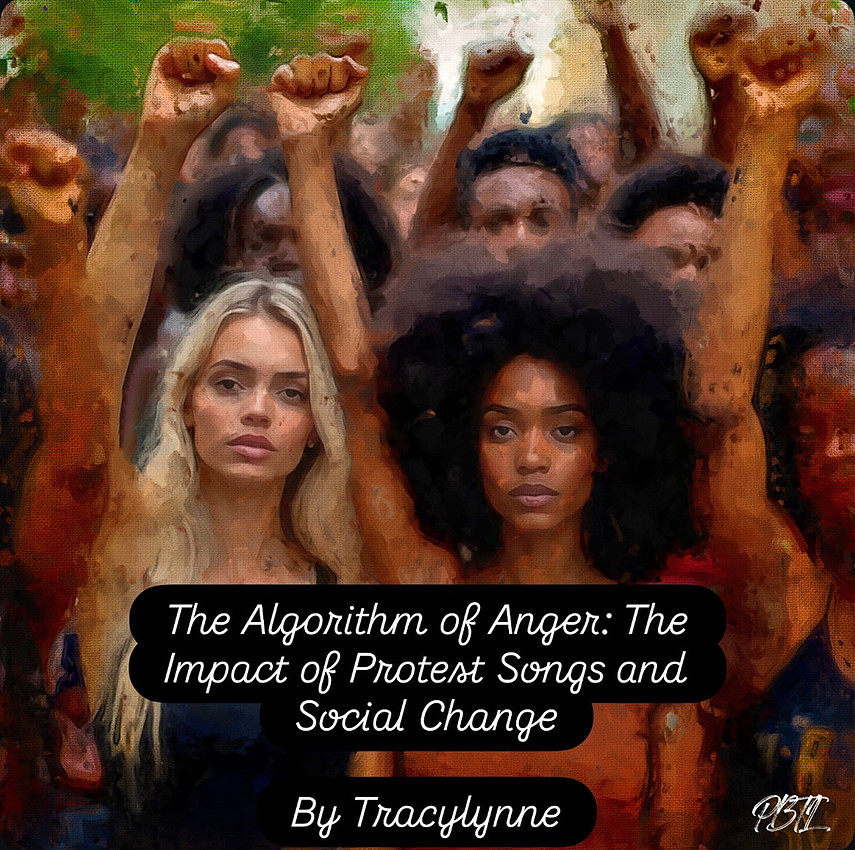

Protest music has always been the soundtrack of truth tellers. I'm not talking about background music for curated performative outrage. This isn’t about vaguely political vibes to signal your allegiances. Real protest music is a sonic tool, a cultural wedge driven into the fault lines of society. It testifies when institutions refuse to listen. It exposes violence when the state hides it. It pushes society forward when the comfortable would rather freeze time.
Having watched movements rise and fall, having felt the sting of real struggle, I can tell you that these songs matter not because they’re poetic, but because they are effective. They change minds, mobilize bodies, and most importantly, they reframe the narrative. Let’s look at the evidence, stripped of sentimentality.
From Billie Holiday and Marvin Gaye to Rage Against the Machine and Kendrick Lamar, protest songs have shaped political consciousness and given movements their emotional spine. Add to that lineage Edwin Starr, Creedence Clearwater Revival, Bruce Springsteen, Hayley Williams, Native Son, and others who used music to confront injustice directly.
Consider the antebellum South. The data point here is the human body, priced and sold. The tool was "Wade in the Water." To the slaveholder, it was a harmless spiritual. To the enslaved, it was an encrypted manual.
The lyric "God's gonna trouble the water" was a direct signal for escapees to use waterways to throw off bloodhounds. Its impact wasn't measured in chart positions, but in successful journeys along the Underground Railroad. This was code, not art, and its societal impact was quantifiable: more free people.
One of the earliest seismic protest recordings was Billie Holiday’s 1939 performance of “Strange Fruit”, as it explicitly protested the lynching of Black Americans in the Jim Crow South. It uses chilling imagery to make listeners see the violence that polite society tried to ignore. Lynching was widespread enough that thousands of African Americans were killed in this way from the late 1800s into the mid-20th century.
Written by Abel Meeropol after seeing a photograph of a lynching, the song described racial terror without euphemism. Columbia Records refused to release it for fear of Southern backlash, so Holiday recorded it with Commodore Records, where it went on to sell more than one million copies according to the Library of Congress. “Strange Fruit” is now part of the National Recording Registry.
But its impact reached beyond culture. It altered Holiday’s life. According to biographical sources cited by the Library of Congress and journalist Johann Hari’s documented research in “Chasing the Scream,” Harry Anslinger, head of the Federal Bureau of Narcotics, targeted Holiday specifically after she refused to stop performing the song. Government surveillance, repeated arrests, and the revocation of her cabaret card in New York limited her ability to earn a living.
Nearly a century on, the song still appears in discussions of racism in America and the role music plays in social movements. Its influence reaches beyond jazz or blues into broader culture and education about race and violence. “Strange Fruit” gave voice to Black America, but Holiday paid the price for its truth.
Fast forward to The Civil Rights Movement. It didn't have a PR firm; it had a songbook."We Shall Overcome" didn't originate in a Greenwich Village café; it was forged on picket lines in South Carolina, evolving from a 1901 gospel hymn. Its adoption was tactical. Sociologist and activist James R. Wood documented how music was used deliberately in meetings to bolster courage and unify diverse groups.
The song became a psychological tool. A 1963 study of sit-in participants published in the Journal of Conflict Resolution noted that group singing significantly increased solidarity and reduced anxiety in the face of violence. The impact? It turned frightened individuals into an immovable community.
The data is in the photographs from Selma: mouths open in song, facing down state troopers. “We Shall Overcome,” carrying roots from spirituals and labor organizing, unified activists during sit ins, marches, and mass meetings. Smithsonian Folkways archives detail how the song traveled across states, jails, churches, and training centers, offering a shared compass for resistance.
Sam Cooke’s “A Change Is Gonna Come,” released in 1964 after Cooke was turned away from a whites only motel, became a prophetic anthem of the movement. NPR and History.com document its rise during major protests including Selma, where the song symbolized a collective insistence on justice.
It became a pivotal song for the Civil Rights Movement, expressing deep weariness with injustice but maintaining a hopeful belief that change is inevitable, earning its place as one of the most important songs in American history.
Now, look at Vietnam. The numbers were stark: over 58,000 American dead, countless more Vietnamese, and a conscription system that pulled from the working class. The protest song became a mass media vector for dissent. Country Joe McDonald's "I Feel-Like-I'm-Fixin'-to-Die Rag" is a case study in sardonic, data-driven critique. "And it's one, two, three, what are we fighting for? / Don't ask me, I don't give a damn, next stop is Vietnam."
The song listed the grim arithmetic: "Be the first one on your block / To have your boy come home in a box." It wasn't subtle. Its impact was amplified when McDonald performed it to 400,000 at Woodstock, a captured audience of the demographic most affected. The song didn't end the war. But it crystallized the absurdist anger of a generation, eroding public support.
Polling data from the era shows a direct correlation between the rise of anti-war media and the precipitous drop in public support for the conflict after 1968. The Vietnam era also introduced two of the most influential protest records of the century: Creedence Clearwater Revival’s “Fortunate Son” and Edwin Starr’s “War.” “Fortunate Son,” released by Creedence Clearwater Revival in 1969, took aim at class inequality in the draft system. John Fogerty wrote it to critique how wealthy and politically connected families often avoided combat while working class Americans were forced into service.
Rolling Stone and the Smithsonian confirm that the song became a defining anti war anthem, highlighting class privilege and government hypocrisy. Its criticism remains relevant in discussions of military inequality today. “War” was released in 1970 through Motown, with Starr delivering its unforgettable shout, “War, what is it good for? Absolutely nothing.”
The song directly criticized U.S. military intervention in Vietnam. It reached number one on the Billboard Hot 100 and became the most prominent anti-war anthem of its year. NPR and History.com confirm that its blunt message reflected growing national opposition to the war and became a rallying cry at protests across the country.
Marvin Gaye expanded protest music’s emotional and political scope with “What’s Going On” in 1971. Addressing pressing social issues of the early 1970s, including the Vietnam War (inspired by his brother's experiences), poverty, environmental destruction, police brutality, and racial injustice, all from a plea for love, peace, and understanding, framed as a reflective conversation with a world in turmoil.
Gaye insisted on releasing the song despite Motown’s initial opposition. It became one of Motown’s fastest selling singles, and Rolling Stone later ranked the entire album as the greatest in modern music history. The song connected racial injustice, war, and poverty into a single indictment of American inequality.
It marked a significant shift for Gaye from love songs to socially conscious music, becoming a powerful statement on the human condition and a call for unity, still relevant today.
Let’s talk economics. The 1970s steel collapse in the American Rust Belt wasn't an abstract concept; it was empty factories and gutted towns. Bruce Springsteen's "The River" isn't just a song; it's an economic report. "I got a job working construction for the Johnstown Company / But lately there ain't been much work on account of the economy."
The impact here is documentary. He gave a voice and a face to the Bureau of Labor Statistics’ unemployment figures. It created empathy grounded in reality, not theory, for the deindustrialization that pundits were just starting to name.
Ironically, Bruce Springsteen’s, “Born in the U.S.A.”, (1984) is frequently misunderstood as patriotic celebration, but its verses sharply criticize the state’s treatment of Vietnam veterans and working class citizens.
Springsteen has explained in interviews with NPR and Rolling Stone that the song is a protest of institutional failure, not a patriotic anthem. History.com classifies it as one of the major American protest songs for this reason.
Public Enemy’s,“Fight the Power”, in 1989 shifted protest music into hip hop. Commissioned for Spike Lee’s film “Do the Right Thing,” the track addressed systemic racism, police brutality, and media narrative control. Hip-hop had long mastered this blend of external and internal siege. Public Enemy’s, "Fight the Power", didn’t deal in metaphors.
It named names: "Elvis was a hero to most / But he never meant shit to me, you see, straight up racist that sucker was." The impact was a reclamation of narrative power. Their 1990 album Fear of a Black Planet debuted at number 10 on the Billboard 200.
This was radical, confrontational politics reaching a mainstream, multi-racial audience, challenging them to confront uncomfortable historical and social truths. The data point is in the reach. Rolling Stone ranks it among the greatest protest songs in American history.
Then came the 1990s. A period of proclaimed peace and prosperity, but also of NAFTA, the expansion of the prison industrial complex, and the Los Angeles riots. The response was not a folk singer with an acoustic guitar. It was Rage Against the Machine. Their impact is a masterclass in deploying radical politics within the heart of the corporate music industry, a deliberate contradiction they weaponized.
Their 1992 self-titled debut album, dense with samples of revolutionary speeches and lyrics citing Frantz Fanon, sold over three million copies without major radio play. The data point is in the platinum certification. Their song "Killing in the Name," an explicit indictment of institutional racism and police brutality, became a number one single in the UK in 2009 after a grassroots campaign to stop a novelty song from claiming the Christmas top spot.
This was not an accident; it was a 17 year delayed proof of concept, showing the latent, organized power of their message. They didn't just sing about uprisings; they played benefit concerts for the cause. They didn't just critique the prison system; they played outside the Democratic National Convention in 2000 with upside down American flags, their performance a direct action that resulted in their arrest.
The impact is measurable in the political awakening of a generation of listeners who encountered thinkers like Subcomandante Marcos and the Black Panthers not in a textbook, but in the liner notes of a CD they bought at the mall. Billboard and the Rock and Roll Hall of Fame document the song’s re-emergence during global uprisings, including the 2020 protests following the murder of George Floyd. Scholars in the Journal of American Studies argue that the band pushed political literacy into mainstream popular culture with unprecedented force.
Protest music in the twenty first century continued to shape movements. Kendrick Lamar’s “Alright,” released in 2015 (often recognized by the refrain “We gon be alright”), became a rallying cry for Black Lives Matter protesters across the country chanted the refrain during demonstrations against police killings, as documented by NPR and The New York Times. From his album, To Pimp a Butterfly, an album that redefined what mainstream rap could be when it grappled honestly with race, trauma, resilience, and systemic oppression.
The recurring promise “We gon be alright” isn’t naive optimism. It’s a declaration of collective endurance in the face of systemic racism and violence. Kendrick meant it as both a personal reassurance and a broader message of hope to communities worn down by inequality. It's a powerful anthem of hope and resilience, addressing Black struggle, police brutality, and systemic injustice while affirming survival and faith.
The impact earned Kendrick Grammy Awards for its uplifting yet defiant message, born from Lamar's reflections on historical oppression and personal demons.
Childish Gambino’s “This Is America” in 2018 combined visual and sonic critique to confront gun violence, racism, and media manipulation and the way entertainment distracts from Black suffering in the United States. Upon its release, it quickly went viral and later won Grammys for Record of the Year and Song of the Year, cementing its impact in popular culture and political conversation.
The hook, “This is America / Don’t catch you slippin’ up / Look what I’m whippin’ up”, warns Black listeners that any misstep in America can be fatal, even as Gambino boasts about success and money. Lines like “Look how I’m livin’ now / Police be trippin’ now” and “Guns in my area / I got the strap, I gotta carry ’em” reference constant over-policing, the fear of police brutality, and the normalization of firearms in marginalized communities.
Later he raps, “This a celly, that’s a tool,” which has been widely read as invoking the killing of Stephon Clark, who was shot by police while holding a cellphone mistaken for a gun. In another section, “You just a barcode…You just a Black man in this world,” he suggests that even wealthy or famous Black people are treated as commodities or threats rather than full human beings.
Throughout the song and video, Gambino dances with schoolchildren while chaos, fires, and police violence erupt in the background, echoing lyrics about flexing, fashion, and partying. This juxtaposition shows how mainstream culture often focuses on catchy dances, memes, and celebrity spectacle instead of confronting systemic racism and lethal force against Black communities.
The repeated chant of “Get your money, Black man” both echoes real survival advice and critiques a worldview that makes economic success the main shield against racism, even though it never fully protects.
“This Is America” sparked widespread analysis, think pieces, and classroom discussions about its symbolism, with viewers dissecting references to church shootings, minstrelsy, and viral dance crazes. Many critics and scholars described it as one of the most important protest works of the 2010s, updating the tradition of socially conscious Black music (from Nina Simone to Kendrick Lamar) for a meme-driven, visually saturated era.
Its impact is measured in metrics: over 800 million YouTube views. Media analysis firm Graphika tracked how the video spawned millions of social media interactions and think pieces within 72 hours, creating a mandatory cultural conversation.
The song forced a data-driven dialogue about gun violence and representation onto platforms otherwise clogged with distraction. CNN and academic analysis in the Journal of Popular Music Studies detail the song’s symbolic and political impact.
It is 2025 and Kendrick Lamar’s name is back on the national tongue, as if it ever left. His Super Bowl halftime performance detonated across media the moment it ended, spawning instant think pieces from cultural critics, political analysts, and academics who rushed to decode every frame.
The performance trended for weeks as viewers argued, analyzed, and rewatched, trying to interpret the layers of symbolism he packed into a twelve minute set.
The show itself was dense with visual cues, staged imagery, and pointed lyrical delivery that commentators quickly identified as unmistakable social and political messaging. Scholars noted that Kendrick’s use of stage design, choreography, and narrative sequencing addressed systemic issues such as race, national identity, and power, all classic hallmarks of protest art.
Several writers and analysts explicitly framed the halftime set as political resistance. An independent academic analysis even described the performance as “political resistance,” emphasizing how Kendrick used visual symbols and lyrical content to challenge entrenched narratives about race and authority in the United States.
The paper identifies the performance as a symbolic act of protest communicated through tightly controlled imagery and intentional lyrical framing.
The night also included a verified flag protest incident. A member of the performance cast displayed a flag bearing the words “Sudan” and “Gaza,” a clear protest message referencing the ongoing wars in those regions. Multiple reliable outlets confirmed the moment, and the NFL issued a public statement clarifying that the display was not part of the planned production.
In the end, Kendrick did what he always does: he performed, and the country revealed itself. Critics dissected the symbolism, fans defended the message, and his performance refused to fade from public discourse long after the lights went out.
Hayley Williams’ 2025 release “True Believer” added contemporary commentary on religious hypocrisy, racial legacy, and cultural mythology in the American South. The lyrics say it all, "They say that Jesus is the way / but then they gave him a white face / So they don’t have to pray to someone they deem lesser than them.”
This directly points to issues of racial representation and how faith has been co-opted in ways that exclude or diminish others.
Addressing Southern history and racism, another part of the song says: “The South will not rise again / ’Til it’s paid for every sin / Strange fruit, hard bargain.”
The phrase “Strange fruit” references the infamous Billie Holiday protest song, mentioned previously about lynchings in the American South, making a clear connection to unresolved racial trauma, additionally, People Magazine notes that Williams directly referenced Holiday’s “Strange Fruit,” drawing a line between past racial violence and present political denial.
“Hard Bargain” points to a historically Black neighborhood in Franklin, Tennessee, near where Williams grew up, tying the lyric to real Black Southern communities and their survival.
And then there's the chorus, “I’m the one who still loves your ghost / I reanimate your bones / ’Cause I’m a true believer.” In interviews around the release, Williams explained that the song stems from her own Southern Christian upbringing and her frustration with how those traditions were sometimes twisted into exclusionary behavior. She has said she wants to speak about racial inequality and faith honestly.
Throughout the song she sings, “I’m the one who still loves your ghost / I reanimate your bones ’cause I’m a true believer,” presenting herself as someone who both mourns and refuses to abandon the South.
“Loving the ghost” means loving the deeper, better possibilities of the region, its people, culture, and potential while acknowledging that it is haunted by unrepented violence and hypocrisy.
In the end, “True Believer” functions as both lament and protest: it insists that the South cannot “rise” until it confronts racism, exploitation, and religious abuse, yet still clings to the belief that such transformation is worth fighting for.
Modern acts like Native Son expanded the reach of protest music into jazz, hip hop, and spoken word fusion. Their work confronts state violence, systemic racism, and the complexity of modern Black identity. Their music appears in activist spaces, university seminars, and community movements, demonstrating how protest music continues to educate and mobilize new generations.
Internationally, Midnight Oil’s “Beds Are Burning” remains a staple in global land rights movements. Human Rights Careers documents its role in elevating Indigenous issues worldwide. Across every generation, protest music reveals what the nation tries to hide. It forces public reckoning. It gives movements cohesion. It fuels imagination. It tells the truth loudly enough that no system can silence it forever.
The through-line here is not emotion, though that is present. It is function. These songs serve as:
*Narrative Weapons: They reframe a complex issue into an undeniable human story.
*Cohesion Algorithms: They mathematically increase group solidarity and reduce the friction of collective action.
*Information Encryption/Decryption: They hide messages from the powerful ("Wade in the Water") or broadcast brutal truths to the masses ("Fight the Power," "Killing in the Name").
*Psychological Infrastructure: As with "True believer," they build and fortify the internal resilience necessary to endure long struggles.
*Historical Data Storage: They archive the emotional and factual reality of an era better than any textbook.
*Systemic Shock Tactics: As exemplified by Rage Against the Machine, they use the infrastructure of the system they condemn to deliver a debilitating jolt to its complacent audience.
From Billie Holiday’s courage to Edwin Starr’s defiance, from Creedence Clearwater Revival’s critique to Marvin Gaye’s plea, from Bruce Springsteen’s indictment to Rage Against the Machine’s fury, from Kendrick Lamar’s affirmation to Native Son’s cultural excavation, protest music remains a transformative force. It exposes injustice. It mobilizes action. Movements shift. The music stays loud.
If you enjoy my work and want to support more of it, you can buy me a coffee: Buy Tracylynne a Coffee