Black Literature Under Siege | The Books They Don't Want You to Read

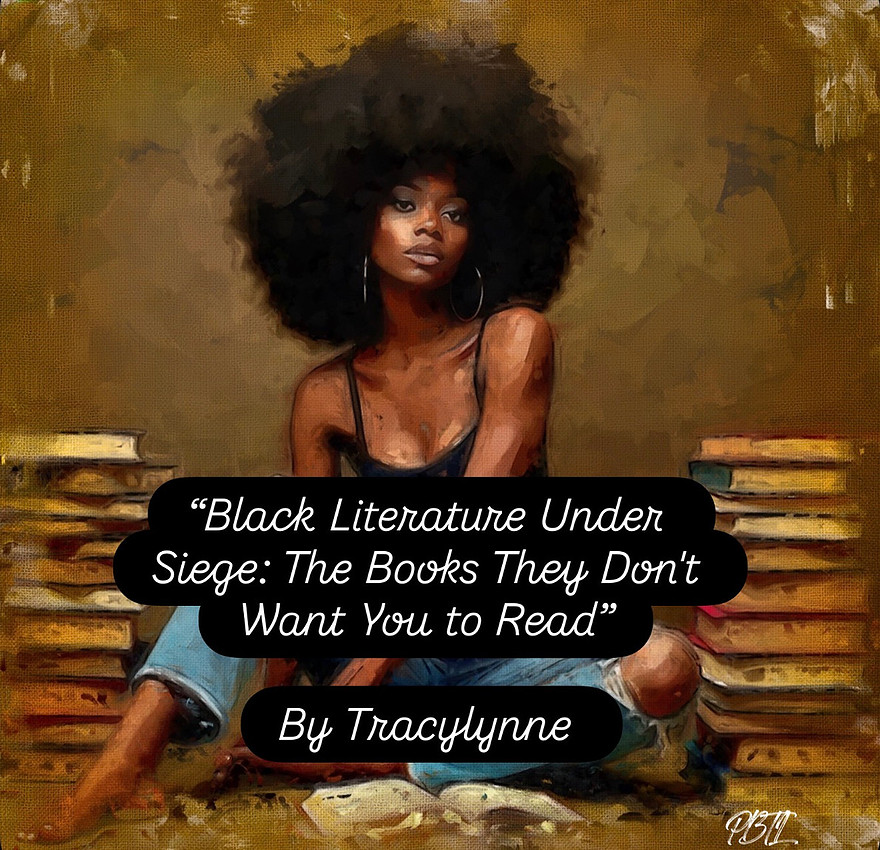

Let us be clear about what is happening in America: the removal of books about Black history, racism, civil rights, incarceration, and Black life is not a misunderstanding. It is not simply a disagreement over what children should read. It is not a harmless exercise in parental concern. It is censorship, and the evidence shows exactly who and what it targets.
The targets are books that name the architecture of racial inequality. They are books that explain slavery beyond the watered-down language of “hard times.” They are books that show how Jim Crow was not ancient history, but a legal, economic, and social system designed to keep Black people politically powerless and economically vulnerable.
They are books that connect redlining, school segregation, police violence, mass incarceration, voter suppression, labor exploitation, and wealth inequality.
These books force readers to confront truths that many institutions would rather package, sanitize, or bury. That is the issue. The problem is not that these books are inaccurate. The problem is that they are often too accurate.
PEN America documented more than 10,000 instances of school book bans during the 2023–2024 academic year, affecting more than 4,000 unique titles. In the following 2024–2025 school year, it recorded 6,870 instances of book bans affecting 3,752 unique titles across 87 school districts.
Those numbers do not represent a small-town dispute over one controversial novel. They reflect a national machinery of removal, restriction, and intimidation.
The pattern is blunt. In PEN America’s analysis of 4,218 unique titles banned during the 2023–2024 school year, 36 percent featured people of color. Among banned history and biography titles, 44 percent featured people of color, and 26 percent specifically featured Black people. That is not random. A quarter of the restricted historical and biographical books were centered on Black lives, Black achievement, Black struggle, and Black experience.
The American Library Association reported that 4,235 unique titles were challenged in 2025, its second-highest annual total on record. Of those titles, 1,671, or 39 percent, represented the lived experiences of LGBTQIA+ people and people of color. The same report found that 92 percent of book challenges were initiated by pressure groups, government officials, and decision-makers.
That matters because it destroys the lazy idea that this is merely individual parents raising isolated concerns. Organized political campaigns are shaping what young people can access.
This is not new. America has a long history of controlling Black literacy because literacy produces questions, questions produce analysis, and analysis threatens systems built on deception.
During slavery, many Southern states enacted laws and customs that criminalized or sharply restricted the teaching of reading and writing to enslaved Black people. The logic was not complicated. An enslaved population able to read abolitionist newspapers, legal documents, religious texts, maps, and political arguments was harder to control. A person who can read can compare what they are told against what has been written. A person who can write can leave testimony behind.
After emancipation, Black communities built schools, colleges, newspapers, churches, mutual-aid societies, and libraries with astonishing speed. Education was not treated as a luxury. It was treated as survival. Formerly enslaved people understood that literacy meant access to contracts, voting information, employment opportunities, legal knowledge, and the ability to document abuse. That is why white supremacist violence repeatedly targeted Black schools, educators, printing presses, and institutions of learning.
The destruction of Black Wall Street in Tulsa in 1921 was not only an assault on homes and businesses. It was an assault on a self-sustaining Black community that had built wealth, professional networks, and institutions in the face of segregation. The Civil Rights Movement was not powered by ignorance, either.
It was built through study groups, church basements, Black newspapers, labor organizing, student activism, legal strategy, and ordinary people who understood that the law had been used against them.
The present-day fight over books belongs in that historical line. The tools may be different, but the instinct is the same: control the story, control the public imagination, and make structural injustice sound like a personal failure.
The classroom is only one front. School censorship receives the headlines, but prison censorship exposes the issue in even sharper terms. When a state imprisons people, it already controls their movement, schedule, contact with family, work assignments, healthcare access, and physical environment. Restricting books becomes another layer of power: control over information, language, self-understanding, and political education.
In a particularly Orwellian twist, books that expose the very injustices of the carceral state are often the first to be banned behind bars. "The New Jim Crow" by Michelle Alexander, a powerful work arguing that mass incarceration serves as a modern system of racial control, has been banned in prisons in North Carolina, Florida, and at the New Jersey State Prison in Trenton. The ACLU successfully challenged the New Jersey ban, but the fact that it was prohibited in the first place speaks volumes.
The state burdened with the widest disparity between White and Black incarceration rates was actively preventing incarcerated people from reading a book about race and mass incarceration. As Michelle Alexander herself stated, prison officials must fear what would happen if people fully understood how biased and corrupt the justice system actually is. In 2026, California prisons even banned a memoir by Dorsey Nunn, a formerly incarcerated community leader, highlighting the continued censorship of rehabilitative literature by Black authors.
PEN America’s 2024 report, "Reading Between the Bars", found staggering prison censorship across the country. Florida had banned 22,825 titles as of September 2023, while Texas had banned 10,265. The report identified restricted titles that included "The Black Panther", "The Final Call", "Understanding the Assault on the Black Man", "Black Manhood and Black Masculinity", "We Do This ’Til We Free Us", "100 Years of Lynching", "Terror in the Night" and "Revolutionary Suicide".
That list should make people uncomfortable because it says plainly what prison systems find dangerous: incarcerated people having access to history, political thought, Black self-determination, racial analysis, and language that makes sense of their lived conditions. Banning that book from prisons is not public safety. It is institutional self-protection.
PEN America has reported that literature on race and civil rights is disproportionately subject to prison bans, often under the argument that it could disrupt institutional order. Texas alone reportedly banned more than 10,000 titles, including Alice Walker’s "The Color Purple". The phrase “institutional order” does a lot of dirty work in this country. It has been used to defend segregation, police brutality, unequal schools, discriminatory housing, and prisons that treat political education as a security threat.
Let us not pretend this happens in a racial vacuum. Pew Research Center reported that Black adults were imprisoned at five times the rate of White adults in 2020. In 2018, Black men were imprisoned at a rate of 2,272 per 100,000, compared with 392 per 100,000 White men. When Black people are disproportionately represented in the institutions restricting books, banning literature about Black history and criminalization becomes more than a library issue. It becomes a barrier to understanding the systems that shaped people’s lives.
Toni Morrison | One of America's Most Frequently Banned and Challenged Authors
No discussion of censorship aimed at Black literature is complete without discussing Toni Morrison. She is among the most frequently banned and challenged authors in the United States, and her work has been a recurring target for decades. "The Bluest Eye", "Beloved", and "Song of Solomon", have all appeared on the American Library Association’s lists of frequently challenged books. In the 2000–2009 period alone, "The Bluest Eye", ranked fifteenth and "Beloved" twenty-sixth among the most challenged books in the country.
Morrison’s novels continue to be targeted because they refuse the comforting myths America tells about itself. Her work confronts racism, slavery, sexual violence, colorism, family trauma, beauty standards, memory, Black girlhood, Black womanhood, and the psychological consequences of living in a society structured by racial domination.
Her writing is often challenged under the language of “sexually explicit” material, graphic violence, religious objection, or content considered inappropriate for young readers. Yet those objections frequently detach difficult scenes from the larger moral, historical, literary, and political purpose of the work.
"The Bluest Eye," for example, is regularly challenged because it depicts rape, incest, racism, and trauma. But those realities are not included for shock value. Morrison uses them to expose what happens when a society teaches Black children that whiteness is beauty, safety, innocence, and worth.
"Beloved" is similarly challenged because it depicts slavery, violence, sexual assault, grief, and the unimaginable choices forced upon enslaved people. But that is precisely what makes the novel essential. Morrison does not permit readers to encounter slavery as a distant chapter in a textbook. She makes them confront its physical violence, emotional terror, and generational aftermath.
It is important, however, to be precise: Toni Morrison has been one of America’s most banned and challenged authors, but she is not consistently the single most banned author in current year-by-year data. In PEN America’s 2023–2024 school-year count, Morrison ranked eighth among the most commonly banned authors, with 116 instances of bans. Still, her persistent presence on these lists matters. It demonstrates that the censorship of Black literature is not incidental; it repeatedly falls upon some of the country’s most significant Black writers.
Her books are treated as dangerous because they do more than tell stories. They expose the emotional machinery of racism. They reveal what structural inequality does inside homes, classrooms, communities, bodies, and imaginations. They make it harder to preserve the fantasy that racial injustice is merely a historical problem or an individual moral failure.
To ban Toni Morrison is not simply to restrict a novel. It is to restrict language for understanding how race, power, trauma, beauty, gender, memory, and history shape American life.
Book bans do not erase history. They do, however, make history harder to access, especially for students whose education depends on what adults choose to place on a classroom shelf.
A suburban student with a well-funded home library, internet access, a parent with time, and a bookstore nearby may still find a banned title. A student in an under-resourced neighborhood may not. An incarcerated reader cannot simply order another copy online or visit a public library. A young person whose school removes Toni Morrison, James Baldwin, Angie Thomas, Ta-Nehisi Coates, Nikole Hannah-Jones, or books about the civil rights movement is being told, through policy, that their history is optional.
That is not neutral. It is a decision about whose humanity deserves complexity.
A country that permits children to read about the American Revolution but treats honest accounts of slavery as divisive is not protecting education. It is manufacturing amnesia. A country that celebrates Dr. Martin Luther King Jr. in January but removes books that explain why he condemned racism, militarism, poverty, and police violence is not honoring him. It is reducing him to a poster quote.
Dr. King wrote in 1963 that “injustice anywhere is a threat to justice everywhere.” Those words are celebrated because they sound clean in a social-media caption. But the full force of King’s work was never clean or comfortable. He opposed segregation, challenged economic exploitation, criticized the Vietnam War, organized poor people across racial lines, and understood that formal legal rights meant little without material justice.
The same is true of the Black Panther Party, Ida B. Wells, Fannie Lou Hamer, W.E.B. Du Bois, Ella Baker, Angela Davis, Malcolm X, Septima Clark, James Baldwin, and generations of people whose work is regularly reduced, distorted, or ignored. Their stories complicate the comfortable version of America. That is precisely why their ideas must remain available.
The response to censorship cannot be panic alone. It must be organized reading, purchasing, teaching, sharing, and protecting access.
Buy books by Black authors when you can. Borrow them from public libraries. Request them through library systems. Support independent Black bookstores. Build reading circles. Donate books to youth programs, reentry organizations, and community centers. Ask local school boards for transparent records of challenged and removed titles. Do not let vague words such as “inappropriate,” “divisive,” “political,” or “controversial” do the work of a serious argument.
Every serious society studies its own record. Germany does not become weaker by teaching the Holocaust. South Africa does not become weaker by teaching apartheid. The United States does not become weaker by teaching slavery, Reconstruction, racial terror, redlining, Jim Crow, civil rights, and mass incarceration. It becomes weaker when it lies about them.
Black history is American history. It is labor history, military history, legal history, music history, religious history, migration history, art history, and political history. It is not a side unit for February. It is not a special-interest topic. It is part of the country’s foundation.
The books being challenged and restricted are not dangerous because they make people hate America. They are dangerous to people who need America to remain misunderstood.
Make no mistake: the current wave of book bans targeting Black history is not a series of isolated, well-intentioned parental concerns. It is a coordinated, anti-intellectual assault designed to sanitize the American narrative and maintain a status quo that benefits a select few.
You cannot understand the present without dissecting the past. That is a fundamental rule of intellectual rigor, a principle that has guided historians, sociologists, and critical thinkers for generations. Yet, across the United States, we are witnessing a calculated, systemic effort to sever that link.
This is not about “protecting children” from difficult topics. It is about controlling the information they receive and ensuring they inherit a distorted, comfortable version of history that glosses over the brutal realities of slavery, the systemic nature of racism, and the ongoing fight for civil rights.
The data is damning. In the 2024–2025 school year alone, PEN America documented 6,870 instances of book bans across 23 states. This is a decline from the previous year’s staggering 10,046 bans, but to see this as a victory is to miss the forest for the trees. Since 2021, nearly 23,000 book bans have been enacted across 45 states. Florida and Texas lead this charge, with 2,304 and 1,781 bans, respectively. This is not a fringe movement; it is a political strategy executed with chilling efficiency.
We are seeing a specific and deliberate targeting of works by and about Black Americans. Books like W.E.B. Du Bois’ seminal "Black Reconstruction in America, 1860–1880" were banned in Lee County Schools, Florida. Du Bois’ work, a landmark historical essay that fundamentally re-evaluated the post-Civil War era and the subsequent rise of Jim Crow, is deemed too dangerous for students to access. Why? Because it provides an unflinching look at the political and social forces that shaped modern America forces that many would rather ignore.
Similarly, "Roots" by Alex Haley, a cultural phenomenon that forced a national reckoning with the horrors of the slave trade, was banned in Tennessee’s Knox County School District. The justification? The subject matter is too much for children. But the book joined a list of 119 titles banned in the district over two years, a list that critics have accurately identified as part of an ongoing effort to whitewash American history. Tennessee, not surprisingly, ranks third in the nation for the most banned books. We are seeing art and history that validate the Black experience systematically removed from public education.
This censorship is not a random occurrence. PEN America’s report "Facts & Fiction" found that the banning of nonfiction titles has doubled, an embrace of anti-intellectualism that devalues education and expertise. We see activism and social movements as the most commonly banned topics. They are targeting books that inspire critical thought and empower individuals to understand their rights.
This trend is a direct echo of the past. In the 1960s and 1970s, right-wing groups mobilized against materials that offered greater representation for women and racial minorities. Mel and Norma Gabler, conservative book analysts, began their attack on textbooks in 1961. Today, the rhetoric has shifted, but the goal remains the same: to enforce a particular ideology and stifle dissent. The recent federal lawsuit in Tennessee challenging book removals on First Amendment grounds is a crucial reminder that this fight is far from over.
The reality is simple: to ban a book is to admit its power. These narratives, historical accounts, and lived experiences are dangerous because they empower a populace that can think critically. An educated, aware citizenry that understands the legacy of systemic racism is a threat to a power structure built on its denial.
This is why "Beloved" by Toni Morrison, a novel based on the true story of an enslaved woman who chose to kill her children rather than see them returned to slavery, is banned. This is why Octavia Butler’s "Kindred", which uses science fiction to explore the brutal reality of slavery, is banned. They are not just stories; they are mirrors held up to society, reflecting a truth that is uncomfortable and inconvenient.
The fight for the preservation of these books is a fight for the integrity of our educational system. It is a fight against the deliberate impoverishment of the public mind. We are talking about the erasure of voices, the silencing of history, and the deliberate dumbing down of a nation. History has always been a battleground, and right now, books are the ammunition. We cannot afford to lose this fight.
Suggested Reading
- "Black Reconstruction in America, 1860–1880" by W.E.B. Du Bois
A groundbreaking historical essay that reframes the post-Civil War era, arguing that Black people were central to the attempt to reconstruct a democratic America, a legacy that was then dismantled by Jim Crow.
- "The New Jim Crow: Mass Incarceration in the Age of Colorblindness" by Michelle Alexander
A searing indictment of the American criminal justice system, arguing that the War on Drugs and mass incarceration serve as a modern system of racial control, functionally reinstating the caste system of Jim Crow.
- "The Bluest Eye" by Toni Morrison
A novel about race, beauty, trauma, family, and the devastating impact of a culture that teaches Black children to see themselves through White standards.
- "Beloved" by Toni Morrison
A Pulitzer Prize-winning novel that confronts slavery’s brutality and its enduring psychological, familial, spiritual, and generational consequences.
- "The Color Purple" by Alice Walker
A powerful novel exploring Black womanhood, domestic violence, survival, spirituality, sisterhood, and self-determination in the early twentieth-century South.
- "Roots: The Saga of an American Family" by Alex Haley
A monumental work of historical fiction that traces the lineage of an African American family from its origins in Gambia through the horrors of slavery, using one man’s family history to tell a universal story of resilience and survival.
- "Kindred" by Octavia E. Butler
A genre-defying novel that follows a modern Black woman who is inexplicably transported back in time to a pre-Civil War Maryland plantation, forcing her to confront the brutality of slavery and its direct connection to her own existence.
- "Homegoing" by Yaa Gyasi
An ambitious historical novel that traces the parallel lineages of two half-sisters in eighteenth-century Ghana, one sold into slavery and the other married to a British slaver, showing how the legacy of the slave trade continues to impact their descendants across centuries.
- "I Am Not Your Negro" by James Baldwin
Baldwin’s unfinished manuscript, shaped into a book and documentary, examines the lives and murders of Medgar Evers, Malcolm X, and Martin Luther King Jr., while confronting the nation’s racial myths.
- "Just Mercy" by Bryan Stevenson
A memoir and legal account of wrongful convictions, death-penalty cases, and the human cost of a criminal legal system that often fails poor and vulnerable people.
- "Black Skin, White Masks" by Frantz Fanon
A foundational work on colonialism, racism, identity, psychology, and the emotional consequences of living under racial domination.
- "100 Years of Lynching" by Ralph Ginzburg
A documented collection that exposes the long history of racial-terror lynching in the United States and the public institutions that tolerated it.
- "The Hate U Give" by Angie Thomas
A young adult novel examining police violence, grief, code-switching, class, community pressure, and the consequences of speaking truth in public.
- "Revolutionary Suicide" by Huey P. Newton
The autobiography of a co-founder of the Black Panther Party, detailing political awakening, state repression, community organizing, and the Black freedom struggle.
- Silencing the Past: Power and the Production of History by Michel-Rolph Trouillot,
The essential book on historical erasure.
- "The Half Has Never Been Told: Slavery and the Making of American Capitalism" by Edward E. Baptist
The erasure of slavery’s economic importance.
- "The Color of Law: A Forgotten History of How Our Government Segregated America" by Richard Rothstein
The “forgotten history” hiding in plain sight.
- "The Black Jacobins: Toussaint L’Ouverture and the San Domingo Revolution" by C. L. R. James,
Recovering a revolution that was pushed out of the Western narrative.
- "Lies Across America: What Our Historic Sites Get Wrong" by James W. Loewen
History deliberately rewritten for the public.
- "How the Word Is Passed: A Reckoning with the History of Slavery Across America" by Clint Smith,
A newer examination of historical memory.
- "The 1619 Project: A New Origin Story" by Nikole Hannah-Jones, ed.
Reframing America’s origin story.
"Lies My Teacher Told Me: Everything Your American History Textbook Got Wrong" by James W. Loewen
How American history is often distorted, sanitized, or selectively presented in high school textbooks.
If you enjoy my work and want to support more of it, you can buy me a coffee: Buy Tracylynne a Coffee
Comments
It's interesting that books on all kinds of topics are permitted in schools and even prisons, yet books that explore Black history and the realities of racism are often the ones being flagged or challenged. I don't think sexually explicit material belongs in elementary or middle school, but if older students can read about sex, religion, violence, and politics, they should also be able to read about race and the history that shaped our country. If we're going to allow students access to challenging ideas, then let's be consistent and not hypocritical about which parts of history and human experience deserve to be discussed.