Where Are the White People?

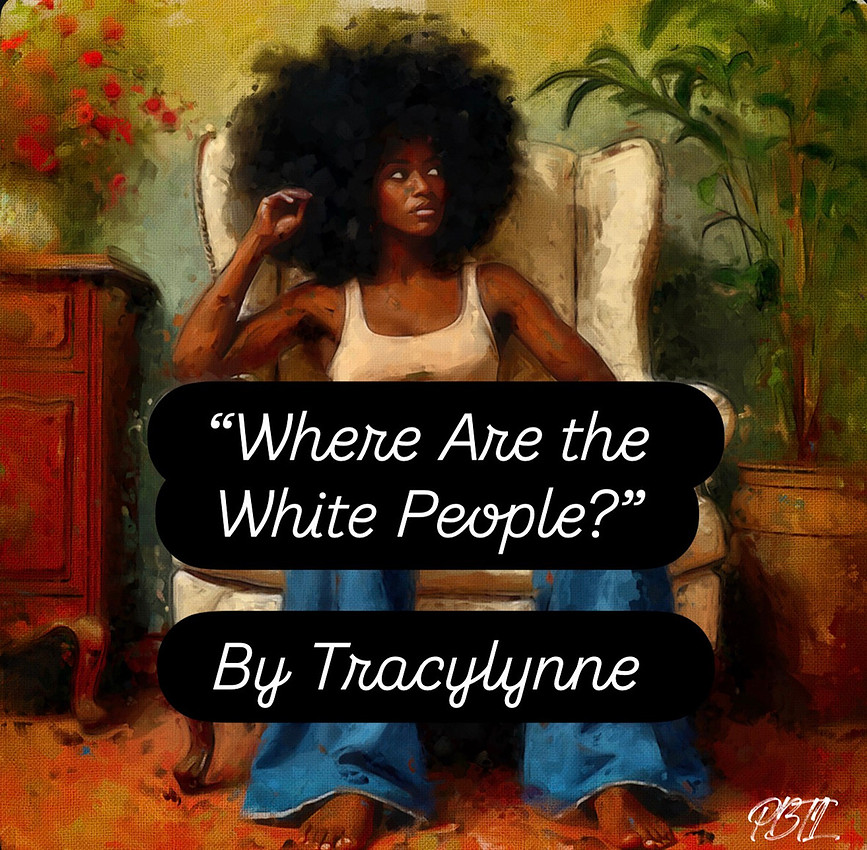

I make Black art. Not accidentally. Not because I have somehow failed to discover that other people exist. Not because I am incapable of painting, photographing, illustrating, or otherwise representing people who are not Black. I make art centered on Black women because being a Black woman is my lived experience.
Sadly, there is a particular moment that every Black artist who centers Black life eventually faces. It is predictable, irritating, and revealing. You show your work to someone who claims to appreciate you, your culture, and your creative voice. They look at your portraits, your scenes, your visual language rooted in Black identity, and they ask a question that exposes far more than curiosity. They ask, "where are the white people?"
The question, "where are the white people?", exposes a documented pattern. Cultural studies research shows that dominant groups often expect to be reflected in all spaces, even when those spaces are not about them.
This expectation appears in media consumption, political discourse, and social interactions. It is not about individuals. It is about the long standing assumption that whiteness is the center of American identity. When confronted with art that does not cater to that assumption, some people respond with confusion or discomfort.
The question is not innocent. It is a deceptively simple question. It is not neutral. It is not simply about aesthetics. It is a reflection of a long documented pattern in American cultural history where whiteness has been positioned as the default reference point.
Scholars have written about this for decades. Sociologist Joe Feagin’s work on systemic frameworks shows how cultural dominance shapes expectations in everyday interactions.
Historian Nell Irvin Painter’s research on the invention of whiteness demonstrates how whiteness was constructed as the universal norm in art, literature, and public life. When someone asks why your Black art does not include white subjects, they are not asking about representation.
It is also a question worth examining because the expectation underneath it is far more complicated than the person asking it may realize. They are asking why your work does not orbit around them.
The issue is the assumption that when Black people center themselves, somebody else has been excluded from something they were supposed to be included in.
Toni Morrison understood this better than almost anyone.
In the documentary, "Toni Morrison: The Pieces I Am", Morrison discussed what she called the “white gaze” and explained that she had spent her writing life making sure that it did not become the dominant perspective in her books. The discussion came partly from criticism she received for writing about Black people.
One review of her novel, "Sula", complained that Morrison was limiting herself by writing about Black people. The reviewer essentially suggested that she would have to mature as a writer by confronting the “real” issue for Black people, which the reviewer identified as white people.
That criticism is extraordinary when you stop and actually examine it. Morrison was not being criticized because she could not write. She was being criticized because she had chosen not to organize her storytelling around white people.
In the PBS American Masters discussion of Morrison, the narrator points out the absurdity of the standard. Nobody considered an Irish writer limited because that writer wrote about Irish people. Morrison herself highlighted the same contradiction.
In another interview, Morrison was even more direct. She explained that she wrote for Black people and rejected the idea that not centering white people made her work limited. She also pointed out that white people do appear in her books, but they do not have to occupy the center of the universe simply because the author is Black.
That distinction is important. Morrison was not arguing that white people should disappear from literature. She was rejecting the idea that Black literature becomes more universal, mature, serious, or valuable when white people become more central to it.
That is a very different proposition. And it applies to visual art too.
There is a historical problem with whiteness as the default. For centuries, American and European cultural institutions established white experience as the presumed center of artistic and intellectual life. That does not mean every white person personally decided this should happen. History is rarely that simple.
It means institutions, cultural gatekeepers, publishers, museums, galleries, universities, critics, collectors and audiences operated within systems in which white people were disproportionately positioned as creators, subjects, interpreters and arbiters of what counted as important culture.
The numbers in the American art world make this difficult to dismiss as merely somebody’s feelings. A 2019 peer-reviewed study published in PLOS ONE examined artist records from 18 major American museums. Researchers analyzed approximately 10,000 artist records representing more than 9,000 unique artists and used roughly 45,000 crowdsourced demographic responses.
Their finding was stark: approximately 85 percent of the artists represented in those museum collections were white and 87 percent were men. That means that if someone walks into a major American art museum and experiences the collection as predominantly white, they are not imagining it.
The National Gallery of Art provides another striking example. Research cited by the National Gallery's own educational material has documented the historic overrepresentation of white male artists in American museum collections. A separate account of the National Gallery's collection found that approximately 97 percent of its artists were white.
So when a Black artist creates work centered on Black people, we should not pretend the cultural landscape is somehow beginning from a position of perfect racial neutrality. It isn't.
The broader art world has historically provided enormous space for white artists to create work about themselves without being required to justify why their subjects are white. Black artists have not always enjoyed that same luxury. That difference did not emerge from nowhere.
Consider the Harlem Renaissance.
Beginning in the early twentieth century, the Great Migration brought millions of Black Americans out of the rural South and into cities across the North and Midwest. The National Gallery of Art describes the Great Migration as the largest resettlement of Americans in the history of the continental United States, driven in significant part by the pursuit of jobs, education and housing and by the desire to escape Jim Crow and institutionalized racism.
Harlem became a center of Black intellectual, artistic and cultural life. Artists, writers, musicians and intellectuals created spaces where Black people could represent themselves without asking permission from a society that had spent generations representing them through racist caricature and stereotypes.
That distinction is critical.
Black artists were not simply making “Black-themed” work because they lacked imagination. They were participating in a larger cultural project of self-definition.
Aaron Douglas developed a visual language that represented Black Americans in a new light. Black artists drew inspiration from African artistic traditions and from the lived realities of Black American life. The National Gallery of Art identifies visual artists as central contributors to the Harlem Renaissance, not merely decorative participants in a literary movement. This was happening in a country where Black representation had long been distorted.
Minstrels had popularized racist caricatures of Black people for white audiences. Black performers were routinely restricted to stereotypical roles. Serious artistic representation of Black life faced structural barriers. The Harlem Renaissance challenged that.
And even that cultural movement existed within a complicated racial economy. White patrons and audiences supported portions of the Harlem Renaissance. White intellectuals and philanthropists provided money, connections and access to publishing and cultural institutions. Some white audiences traveled to Harlem specifically to consume Black cultural expression.
The National Gallery of Art notes that white visitors were drawn to Harlem's nightlife and artistic culture, while Black artists and communities were creating something much deeper than entertainment. There was therefore a strange contradiction.
Black people were creating spaces in which Black life could finally be centered, while white America continued to exercise enormous influence over which Black artists received money, visibility and institutional recognition. That tension did not disappear after the Harlem Renaissance. It simply changed clothes.
Even the Federal Art Project, one of the major New Deal programs designed to employ artists during the Great Depression, reflected racial discrimination. The Saint Louis Art Museum documents that portions of the New York Federal Art Project were effectively segregated by race, with relatively few African American artists working in certain divisions.
In response, members of Harlem's artistic community established the Harlem Community Art Center, which opened in 1937 with Federal Art Project support and provided free art instruction and opportunities for Black artists.
Read that again.
Black artists had to build additional institutional spaces because existing structures were not providing equal access. So when a Black artist today says, “I make Black art,” that statement exists within a historical tradition of Black artists creating room to represent Black life on their own terms. It is not an act of cultural amnesia. It is part of the record.
The strange idea that white people need to be included...this is where the question “Where are the white people?” becomes revealing.
The person asking may not intend anything malicious. Intent matters, but it is not the only thing that matters. Language carries assumptions.
If someone walks into an exhibition devoted to Black women and immediately wonders where the white people are, the question can reveal an expectation that whiteness should be represented even in spaces intentionally designed around another racial experience.
But the expectation itself has a documented historical context. For much of American cultural history, white experiences were allowed to function as the unmarked category.
White characters were simply “characters.”
White stories were simply “stories.”
White neighborhoods were simply “neighborhoods.”
White history was simply “American history.”
Black stories were more often labeled.
Black literature.
Black art.
Black history.
Black music.
Black studies.
Black culture.
The label itself often became evidence that something was supposedly specialized, particular or separate, while white culture could continue presenting itself as universal. That is the part people need to understand. When whiteness occupies the center, it can become difficult for the center to recognize itself as a center.
A person accustomed to seeing their own identity represented everywhere may experience the absence of that representation as exclusion, even when nothing has actually been taken from them. That is not the same thing as structural exclusion. Those two concepts should not be confused.
There is another problem with the question, "where are the white people?", it assumes that art centered on Black people is somehow specifically for Black people, while art centered on white people can automatically be understood as being for everyone. History does not support that distinction.
Shakespeare wrote about English society.
Tolstoy wrote from within Russian society.
Jane Austen wrote extensively about English social life.
Frida Kahlo made her Mexican identity central to her work.
Georgia O'Keeffe repeatedly drew from particular landscapes, places and forms.
None of these artists became less significant because their work emerged from specific cultural experiences. Specificity and universality are not opposites. In fact, specificity is often how people encounter the human experience. A person does not have to share an artist's race, gender, nationality, religion, geography or historical experience to find meaning in that artist's work.
That is one of the great things art can do. It allows people to enter experiences that are not their own. But there is an important distinction between being invited into somebody else's story and demanding that the storyteller rewrite the story to make you the center.
Those are not the same thing. When I create a portrait of a Black woman, I am not making a political statement simply because she is Black. Her Blackness is not an apology. Her Blackness is not an omission. Her Blackness is not a placeholder for a person who should have been white. She is the subject because I chose her as the subject.
That should be enough.
If a white artist paints a series of white women, nobody reasonably expects that artist to interrupt the series and announce, “Wait, I need to add a Black woman so this can be considered legitimate art.”
But when a Black artist deliberately centers Black people, the work can suddenly be treated as incomplete because somebody outside the intended subject group cannot locate themselves in it.
That double standard deserves examination. Sometimes the subject is simply not you. And that is okay. Actually, it is healthy.
The documented history of American cultural institutions makes another point unavoidable. Black people have historically been underrepresented in many mainstream art institutions, publishing structures and cultural spaces.
That history includes segregation, exclusion from educational opportunities, unequal access to galleries and museums, discriminatory hiring and collecting practices, and editorial decisions shaped by predominantly white publishing institutions.
Scholar John K. Young's work on Black writers and white publishers documents numerous examples of African American authors navigating publishing systems in which white editors and publishers possessed considerable institutional power. His research includes Jean Toomer, Nella Larsen, Richard Wright and Toni Morrison, among others. This does not mean white people had no relationship to Black art. They absolutely did.
It means the relationship was historically complicated by unequal power. That distinction matters. And when the starting point is already disproportionately white, asking a Black artist why her work does not contain more white people requires a little historical perspective.
It is like walking into a room that has been decorated with one color for generations and complaining about the one corner that finally looks different.
The Black artist did not create the imbalance. She simply chose not to reproduce it.
There is a difference between exclusion and de-centering. This distinction is probably the most important part of the conversation. Exclusion means denying someone access because of their race. De-centering means choosing not to make that person's experience the organizing principle of your work. Those are not equivalent.
Toni Morrison's career makes this point with extraordinary clarity. She did not become one of America's most important writers by constantly asking whether white readers were comfortable enough. She became one of America's most important writers while insisting that Black interiority was worthy of literary attention without needing white validation.
For generations, Black Americans have had to become experts at finding ourselves in spaces that were not built with us in mind. We learned to appreciate art that did not look like us. Read books where the protagonists did not look like us. Watched television where our families were missing or stereotyped. Entered institutions where very few people looked like us. Studied history that often treated our ancestors as a footnote rather than historical actors. And we still managed to see ourselves.
That is one reason the demand for white representation in explicitly Black-centered work can feel so strange. Black people have spent generations learning how to see humanity beyond racial sameness. We have had no choice.
That does not mean white people are incapable of doing the same. It means the expectation should not be that Black artists must make their work racially accommodating in order for everyone else to feel represented.
Black art does not need a white person in the frame to prove that I understand the world. It does not need a white face standing beside a Black face to demonstrate balance. It does not need to dilute Blackness to make Black art legitimate. And it certainly does not need to apologize for existing.
At the end of the day there is a much more interesting question a person can ask when they encounter art centered entirely on Black people.
Instead of asking, “Where are the white people?”
Ask, “What is this artist saying about Black life?”
Ask why the artist chose these subjects.
Ask what the composition communicates.
Ask what histories, aesthetics, memories or cultural references are embedded in the work.
Ask what you are seeing that you may not have encountered before.
Ask what it feels like to enter an artistic world that was not constructed around you.
That last question may be uncomfortable.
Good.
Not every experience of art needs to provide immediate recognition. Sometimes the value is precisely in encountering something outside yourself. That is one of the reasons museums, books, theater, photography, painting and film matter.
They expand the boundaries of what we know. And perhaps that is the real lesson here. Those questions lead somewhere. And the answers lead straight into American history. It developed in a culture where white people were disproportionately represented in the institutions that defined art, literature, history and cultural legitimacy.
The answer is not to reverse that hierarchy. The answer is to stop requiring Black artists to participate in it.
So, where are the white people? In plenty of other art.
In museums.
In galleries.
In books.
In films.
In advertising.
In television.
In advertising campaigns.
In portraits.
In historical paintings.
In contemporary photography.
In the cultural record.
They are not missing.
They simply are not the subject of my work.
And that distinction should not be difficult to understand.
I am a Black artist making Black art.
I am not asking permission to center Black people.
I am not asking anyone to apologize for being white.
I am not demanding that white people stop creating art about white people.
I am asking for the same freedom.
The freedom to look at my own people and say, “They are worth painting.”
The freedom to create without making whiteness the reference point.
The freedom to tell a story without inserting someone else into it simply because they are accustomed to being there.
That is not exclusion.
That is artistic autonomy.
And after centuries of other people deciding how Black people should be seen, described, painted, photographed, published and represented, I think we have earned the right to decide for ourselves. The Black canvas does not owe anybody a seat at the center.
Hence, when a Black artist chooses to center Black subjects, it is not exclusion. It is correction. It is reclamation. It is a deliberate act of cultural repair. It is a refusal to continue the historical erasure that has been documented by researchers across multiple fields. It is a declaration that Black life is worthy of being seen without needing proximity to whiteness.
Black art is not responsible for soothing that discomfort. My art is not responsible for expanding itself to include subjects that do not belong to the story you are telling. My art is not responsible for reinforcing a hierarchy that has already been challenged by generations of Black creators who refused to dilute their vision.
The truth is simple. Black art does not need white subjects to be complete. Black art does not need white validation to be legitimate. Black art does not need to explain its absence of whiteness. Black art stands on its own history, its own cultural lineage, and its own intellectual foundation.
The question, "where are the white people ?" Is both a critique and a confession. It reveals who has been centered for so long that anything outside that center feels unfamiliar. It reveals how deeply cultural dominance shapes perception. It reveals how much work remains to be done in shifting the understanding of art, identity, and representation.
My work is part of that shift. It is part of a documented movement of Black artists reclaiming narrative space. It is part of a lineage that includes Morrison, Douglas, Elizabeth Catlett, Kerry James Marshall, and countless others who refused to make whiteness the gravitational force of their creativity. It is part of a cultural correction that is supported by historical data, academic research, and lived experience.
My art is Black because my story is Black. That is enough. It has always been enough.
If you enjoy my work and want to support more of it, you can buy me a coffee: Buy Tracylynne a Coffee
Comments
Despite being from the Detroit area, much of my life has still been spent seeing people who look like me reflected in art, media, books, and history. Your point about stepping into a story that isn't built around me made me reflect. Rather than feeling excluded, I feel invited to listen, learn, and appreciate experiences beyond my own.
Thank you for sharing both the historical context and your personal perspective with such insight. Your art is beautiful, your message is meaningful, and your subjects are absolutely worth painting, celebrating, and centering. ❤️