The Same People Ignoring Your Work Will Celebrate Your Success

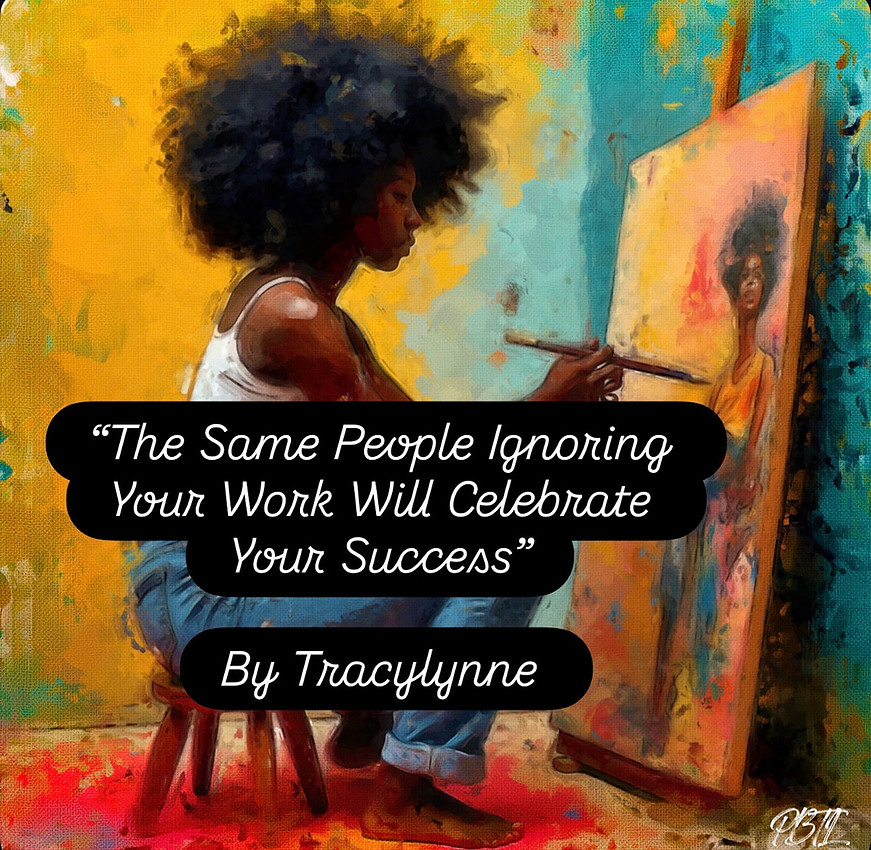
 There is a brutal lesson every entrepreneur, artist, musician, writer, photographer, designer, filmmaker, and creator eventually learns: people do not gather around struggle. They gather around success. That is not cynicism. That is history.
People love victory laps. They love sold out shows, viral clips, magazine covers, six figure launches, celebrity co signs, luxury offices, award speeches, and “overnight success” stories that actually took fifteen years and emotional warfare to build. What they rarely love is the part where you are exhausted, underfunded, doubted, borrowing equipment, sleeping four hours a night, getting ignored online, and praying your card does not decline while trying to finance a dream nobody around you fully understands. The world has always operated this way.
Consider the life of Madam C.J. Walker. She did not build an empire because her neighbors in Louisiana or St. Louis thought a black woman in the early 1900s could revolutionize the hair care industry. She built it because she recognized a need and refused to let the apathy of her peers dictate her worth. When she was selling door to door, the support was nonexistent. It was only after she became the first female self made millionaire in America that the narrative shifted from skepticism to claimed association. People love to say they knew you when, but very few can say they helped you become.
When Henry Ossawa Tanner, one of the first internationally recognized Black American painters, began his career in the late 1800s, he struggled for years in the United States. His own community did not always understand his work, and the broader society certainly did not support it. It was not until he moved to Paris that he found recognition. The same people who overlooked him later claimed him as a hometown hero. The pattern repeats across generations. People rarely invest in the seed. They only celebrate the harvest.
Vincent van Gogh sold almost no paintings during his lifetime. Now his work is worth millions. Zora Neale Hurston died in poverty and was buried in an unmarked grave before the literary world finally acknowledged her brilliance. Nipsey Hussle spent years independently building his brand through mixtapes, community investment, and ownership before mainstream America suddenly called him a genius. The same machine that ignores people during construction often rushes to celebrate them once the building is complete.
Human beings are drawn to proof. They are drawn to evidence of winning. They trust applause more than vision. That is why entrepreneurship requires a level of psychological endurance most people do not possess.
Some of the hardest truths arrive through family and close friends. Society sells people a fantasy that your inner circle will automatically become your biggest cheerleaders. Reality tells a different story. Familiarity often breeds invisibility. People close to you can become so accustomed to your presence that they stop recognizing your value. They still see the version of you who borrowed lunch money, got dumped, struggled in school, cried after breakups, or lived with your mother. It becomes difficult for them to mentally update the file they carry about you. That is why strangers will sometimes support you harder than relatives.
A stranger discovers your work without emotional history attached to it. They only see the quality. Family sees your evolution through old memories, old failures, old identities, and sometimes unresolved jealousy. Nobody likes discussing that part because it makes people uncomfortable. But discomfort does not erase truth.
The data supports this psychological distance. Social studies on tribalism and success often point to a phenomenon where those closest to you feel threatened by your evolution. It is called the Crabs in a Bucket syndrome, but in academic circles, it is often discussed as social leveling mechanisms.
According to recent entrepreneurial sentiment surveys, nearly 60 percent of small business owners report that their primary support system friends and family is the least likely group to actually purchase a product or service. They will hit a like button because it costs them nothing, but they will not hit the checkout button. They see the struggle, they see the late nights and the depleted bank accounts, and they subconsciously distance themselves because humans are evolutionarily wired to avoid failure.
Success is a magnet, but struggle is a repellent.
According to data from the U.S. Bureau of Labor Statistics, approximately 20 percent of small businesses fail within the first year and roughly 50 percent fail within five years. Those are not motivational poster numbers. Those are survival statistics. Most people watching you know those numbers too, even subconsciously. That is why they hesitate to invest emotionally, financially, or publicly in someone still fighting to establish themselves.
People do not want to attach themselves to uncertainty. They want association with outcomes.
That is why you cannot build your business around external validation.
Too many talented people waste years emotionally bleeding over who did not repost their flyer, who never bought their album, who watched every Instagram story but never purchased a product, who said “I got you” and disappeared the second support required money, time, effort, or inconvenience.
Meanwhile, the entrepreneur keeps refreshing analytics looking for affirmation from people who already made their position clear through action. Support is not what people say. Support is what people consistently do. There is also a deeper social reality at work here. Success is aspirational. Struggle is contagious.
People naturally gravitate toward environments that make them feel inspired, elevated, entertained, informed, or emotionally rewarded. They avoid environments that remind them of instability, sacrifice, uncertainty, and fear. Your early entrepreneurial journey often represents all four.
That does not mean people are evil. It means most people are psychologically wired toward security. Research around the creator economy reflects this harsh imbalance. Goldman Sachs projected the creator economy could approach half a trillion dollars by 2027. Yet studies consistently show only a tiny fraction of creators earn substantial income. Wikipedia’s summary of creator economy research notes that as few as 0.1 percent of creators are able to earn a living through their content creation work. Think about that for a second.
Millions of people upload content, launch businesses, create art, record podcasts, design clothing, write books, and build brands every day. Most will never see meaningful financial return. The public knows this. Even if they cannot quote the numbers, they feel it intuitively. So they wait. They watch. They observe from a safe distance until visible success arrives.
Then everything changes.
The same people who ignored your events suddenly ask for tickets.
The same people who never shared your business suddenly tell others they “always knew you had it in you.”
The same people who could not spend twenty dollars on your product suddenly want access to your network, your audience, your opportunities, your influence, your knowledge, and your platform.
Success rewrites their memory.
Once people see proof of concept, they retroactively edit their support in their own minds. That is why entrepreneurs who survive long enough eventually stop taking the lack of support personally. They understand human behavior too well. You have to learn how to clap for yourself while the room is silent. That is not arrogance. That is survival. Muhammad Ali called himself “The Greatest” long before the world fully agreed. Floyd Mayweather mastered self promotion because he understood attention has economic value.
You cannot wait for applause to develop confidence.
The applause usually comes after the confidence.
Entrepreneurship is deeply psychological. Most people think business failure comes from lack of talent. Sometimes it does. But more often, people collapse emotionally before they fail financially. Isolation destroys them. Lack of validation destroys them. Comparison destroys them. Embarrassment destroys them. Watching less talented people receive support destroys them. So they quit. Not because the vision was wrong, but because they expected emotional reinforcement from spectators who were never emotionally invested in the mission to begin with.
You have to stop romanticizing support.
Nobody owes you reposts.
Nobody owes you purchases.
Nobody owes you attendance.
Nobody owes you belief.
Once you fully understand that, you become dangerous because now your discipline no longer depends on emotional permission from other people. You stop wasting energy tracking who did not clap. You start focusing on the people who did. Even if that number is small. Especially if that number is small.
History repeatedly shows that major movements often begin with tiny circles of believers. The civil rights movement, independent music movements, underground art communities, grassroots political organizations, and startup companies all began with small groups before reaching mass recognition. Visibility usually arrives after persistence, not before it.
People respect endurance more than potential.
Anybody can announce a dream. Very few can survive the lonely middle between obscurity and success.
That middle is where entrepreneurs are forged.
That middle is where self belief becomes mandatory.
That middle is where you learn whether your vision belongs to you or belongs to public approval.
Because if your confidence collapses every time someone ignores your work, entrepreneurship will emotionally dismantle you piece by piece.
You have to become the first investor in your own belief system.
You have to become the first audience.
You have to become the first applause.
You have to become the first headline.
Believe your own hype before the world catches up.
Not because you are delusional, but because every major success story begins with somebody seeing value before the crowd recognized it.
The crowd almost always arrives late. Humanity has a long documented history of overlooking brilliance during development and celebrating it once success becomes undeniable. People trust what has already been validated. Entrepreneurs survive by moving before validation appears. So stop counting who did not support you during the struggle. The struggle was never attractive to spectators anyway. Victory is what draws crowds.
Your job is to learn to clap for yourself and survive long enough to reach it.
If you enjoy my work and want to support more of it, you can buy me a coffee: Buy Tracylynne a Coffee