Why Women are Choosing Peace Over Relationships & Why This Angers Some Men

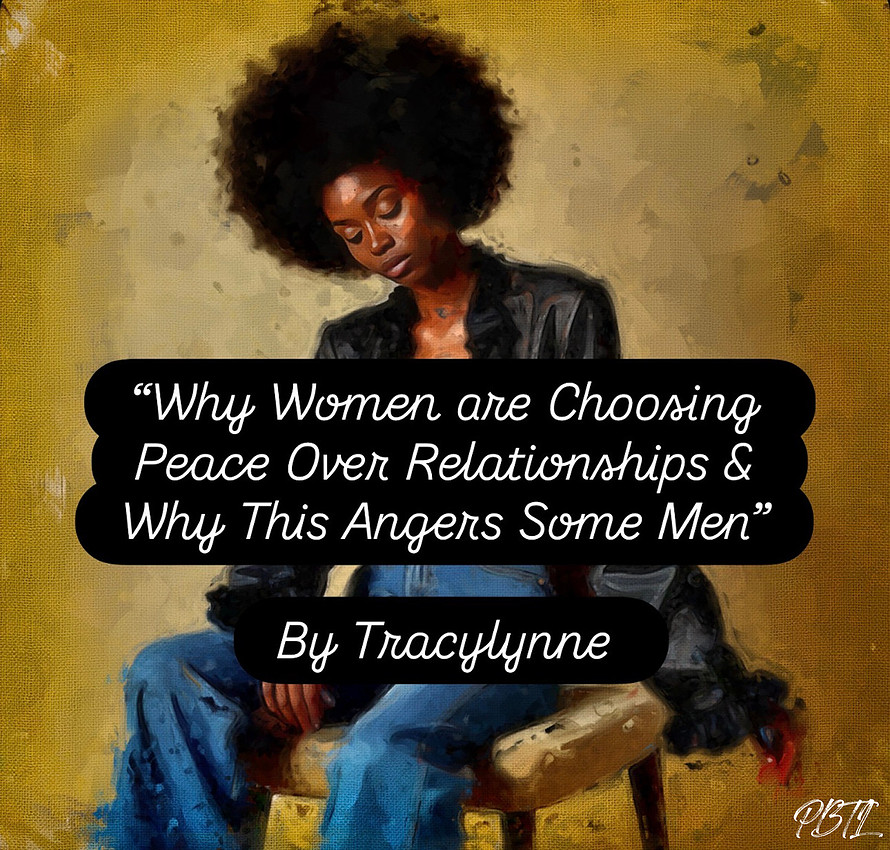
 Across multiple countries, women are opting out of marriage and long term heterosexual relationships at higher rates than at any point in recorded modern history. This trend is visible in census data, sociological research, and longitudinal studies on household formation. Women are not confused, misled, or suffering from some collective delusion. They are responding rationally to incentives, risk, and lived outcomes.
This decline is not a coincidence; it is a direct consequence of women gaining the economic power to choose their own lives. When a woman can secure her own shelter, her own sustenance, and her own future, the utility of a relationship historically a financial necessity evaporates.
Sadly and predictably, rather than asking why women are choosing to be single, many men fixate on attacking the women who opt out. They are consumed with policing and insulting the choice itself. They ignore the realities that made partnership less appealing. This avoidance is not confusion. It is structural.
The core of the “why” is that for many women, singlehood is not a deficit; it is a net gain in quality of life. Women are increasingly choosing to fulfill their lives with travel, friends, pets, and hobbies a process known as decentering men. This is a rational response to the disproportionate “relationship tax” levied on women in heterosexual partnerships.
Historically, whenever women assert autonomy, backlash follows. The suffrage movement was framed as dangerous and destabilizing. Women entering the workforce were portrayed as unnatural and corrosive to family life. Divorce was treated as a moral failure rather than an escape from harm. Each time, the objection was not truly about stability or social cohesion. It was about control.
Choosing singlehood is not a rejection of love. It is a rejection of systems that demand sacrifice without reciprocity. If men want relationships, the question is not how to convince women to return. The question is what kind of partnership they are offering. Safety. Emotional maturity. Shared labor. Accountability.
Respect for autonomy. These are not radical demands. They are baseline expectations. Women are not opting out of relationships. They are opting out of inequity. That distinction explains the anger.
For much of history, women did not partner with men because relationships were emotionally fulfilling or safe. They partnered because survival required it. Until the twentieth century, women in the United States could not open bank accounts, secure credit, own property independently in many states, or access higher education at scale.
Marriage functioned as economic necessity. Patriarchy was not subtle about this arrangement. It was explicit. Sociological research consistently demonstrates that women in heterosexual relationships perform a greater share of household chores and, crucially, emotional labor. This labor includes managing the relationship’s logistics, anticipating a partner’s needs, and performing the thankless task of emotional regulation for two
As legal and economic barriers slowly eroded, the value proposition of compulsory partnership changed. When women gained access to wages, education, reproductive autonomy, and social mobility, marriage stopped being a requirement and became a choice. Choices invite scrutiny. Obligations do not.
Men’s discomfort with women choosing singlehood is rooted in the loss of assumed access. Patriarchy trained men to expect women’s emotional labor, domestic work, sexual availability, and reproductive capacity as defaults. When women opt out, it is not read as neutrality. It is read as rejection, and it is often met with hostility.
This hostility helps explain the intensity of the reaction to the viral thought experiment in which women were asked whether they would rather encounter a bear or a man while alone in the woods. Large numbers of women chose the bear. Not because bears are harmless, but because the risk is predictable. A bear does not gaslight. A bear does not perform false benevolence. A bear does not blame you for its violence.
The outrage from some men was swift and revealing. Rather than asking why women assessed male presence as the greater risk, many men focused on being offended by the comparison itself. That response missed the point entirely. Risk assessment is not about feelings. It is about patterns.
What followed was reflexive vitriol that told women everything they needed to know about why they walked away. When a woman states she is single by choice, a certain type of man does not ask why. He reaches immediately for the insult playbook, worn thin from repetition. Enjoy your cats. You will die alone with your wine. Who is going to protect you. Good luck finding someone when you are older.
These statements are not warnings. They are admissions.
Notice what is missing. These men never say, you will miss the depth of companionship I could offer. They never say, it is a shame you will not experience my emotional intelligence, consistency, or care. The rage is not about love lost. It is about entitlement denied.
He is angry because she has assessed his emotional vacancy and decided that a curated life of books, friendships, travel, hobbies, and yes, the uncomplicated loyalty of a pet offers a higher return on investment.
He is angry because he has lost assumed access to her emotions, her body, and the validation of his legacy. This is not debate. It is not concern. It is the sound of perceived utility being revoked. It is also the clearest evidence validating the female exodus.
The familiar question of who is going to protect you is particularly rich with irony. Historically and statistically, women are most endangered by the men they know, not by strangers, animals, or imagined threats. Data from the Department of Justice consistently shows that women are far more likely to experience violence, sexual assault, and coercive control at the hands of intimate partners and acquaintances than from unknown assailants.
When men invoke protection while simultaneously using their words to intimidate, belittle, and threaten women, they expose the protection narrative for what it is. It is not safety. It is a conditional truce. Women choosing the bear were articulating a rational evaluation of threat based on evidence and experience.
Beyond physical safety, emotional and psychological labor remains profoundly uneven. Decades of sociological research on heterosexual relationships demonstrate that women continue to perform the majority of unpaid domestic work, emotional regulation, and relational maintenance, even when working full time.
Men benefit materially and emotionally from relationships more than women do, while women experience increased stress and decreased leisure after partnership and marriage.
Women are increasingly reporting a lack of physical, emotional, and mental safety within traditional heteronormative structures. Data from the General Social Survey indicates that while married men are often the happiest demographic, the same does not hold true for married women.
Single women frequently report higher levels of life satisfaction because they have replaced the volatile promise of protection with the tangible security of their own resources, social networks, and peace of mind.
The so called cat lady trope is especially revealing. It is deployed as an image of pathetic isolation. But examine it closely. A woman in a home she maintains, with a companion that offers affection without demands, living in quiet autonomy. This is framed as a failure.
Contrast that with the alternative she is being warned toward. A relationship in which she is unprotected from emotional volatility. A domestic arrangement where her labor is expected and her boundaries are negotiable. A partnership where protection comes at the cost of autonomy.
The insult attempts to pathologize her sanity. It is collective gaslighting, designed to make the cage seem safer than the open field. The fixation on cats mocks women for choosing companionship that does not require obedience or self erasure. The warnings about aging reveal a belief that a woman’s worth depreciates unless secured by male ownership. None of this is concern for her well being. It is resentment over lost access.
This mindset proves the woman’s point with devastating efficiency. The rage at her choice becomes the final data point in her risk assessment. It demonstrates that his primary concern is not her happiness, safety, or fulfillment. It is her refusal to comply.
A person who responds to your life choice with contempt and fear mongering is not invested in your well being. He is invested in your dependency. His anger is the very dynamic she is choosing to avoid. It is the emotional stuntedness she is exhausted from managing. It is the lack of safety she feels.
A bear is a known danger. A man who turns hostile the moment he is not chosen is an unpredictable one. The former is a physical risk. The latter threatens peace itself.
The question men should be asking themselves is not “How do we get these women back?” but “What is it about us that makes a bear a more appealing companion?” The answer is that the bear is honest about its nature. The bear does not demand emotional labor, nor does it carry the weight of centuries of systemic entitlement.
Women are decentering men, and they are doing so for good reason. They are building lives rich with purpose, community, and self-determination. The male upset is simply the sound of the old world crumbling, and frankly, it is a sound that should be heard, acknowledged, and ignored. The era of the default male partner is over. The era of the intentional, self-sufficient woman has arrived, and she is not looking back.
Women are not walking away from men because they hate men or because they are bitter. They are walking away because the cost benefit analysis no longer makes sense. Emotionally stunted men are not a fringe group. Research on emotional literacy, conflict resolution, and mental health stigma shows that men are less likely to seek therapy, less likely to develop emotional vocabulary, and more likely to externalize distress through anger or withdrawal.
The choice of singlehood is the ultimate act of walking away from the patriarchy and the demands of a society that has historically defined a woman’s worth by her relational status. It is a declaration that a woman’s time, energy, and emotional capacity are finite resources that will no longer be spent on a deficit relationship.
Women are no longer willing to function as unpaid therapists, mothers, and rehabilitation centers in romantic relationships. Safety is not only physical. Emotional unpredictability, contempt for boundaries, dismissal of interior lives, and entitlement to access create environments that feel unsafe even without overt violence.
The nervous system does not distinguish between physical threat and chronic emotional stress. For many women, singlehood is not a compromise; it is the path to greater well-being, freedom, and self-curation.
Women are not choosing cats over men. They are choosing autonomy over instability. Peace over emotional labor. Safety over entitlement. Women are listening to their bodies and choosing peace. And the anger that follows only confirms that the choice is rational.
If you enjoy my work and want to support more of it, you can buy me a coffee: Buy Tracylynne a Coffee