AI Digital Blackface: The Obsession with Black Culture Continues

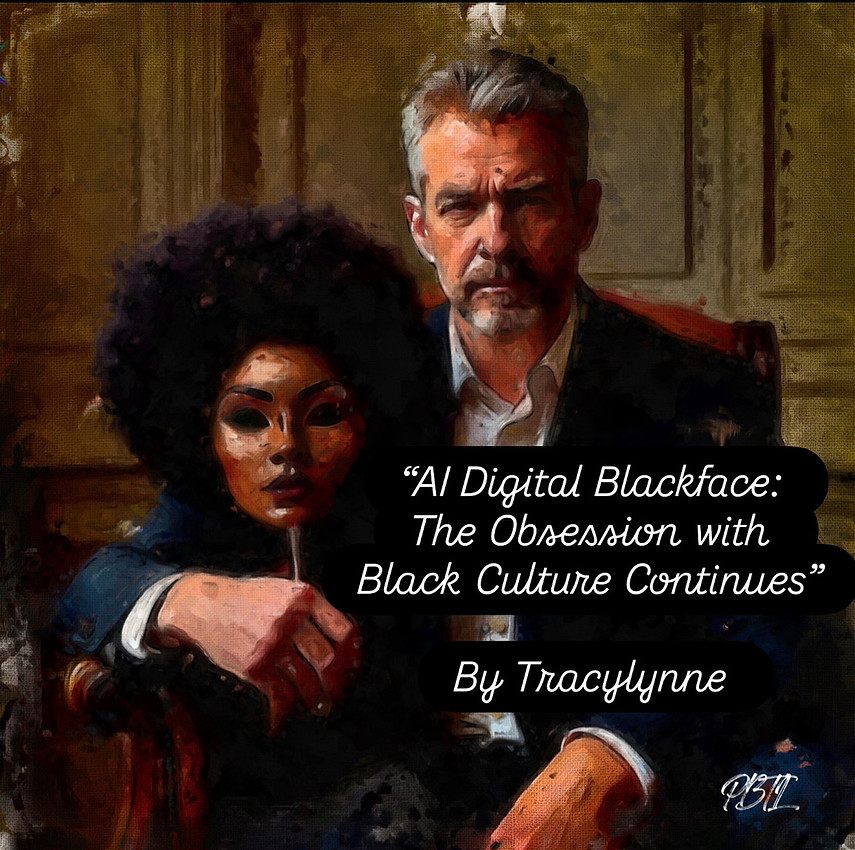

There is a particular kind of audacity involved in building a business around Black identity when the people collecting the profits are not Black, the people making the decisions are not Black, and the Black people supposedly represented in the marketing may not even exist.Yet this is where technology and commerce have brought us.
Black faces sell products. Black voices sell music. Black language generates engagement. Black aesthetics influence fashion, beauty, advertising, and entertainment. And increasingly, artificial intelligence allows businesses to reproduce those cultural signals without employing the very people whose identities give them meaning.
What makes this disturbing is not simply that non-Black people are participating in industries influenced by Black culture. That has been happening for generations, sometimes through legitimate collaboration and sometimes through documented exploitation. It is that Blackness itself can be manufactured into a marketing asset.
A company can create a photorealistic Black model, generate a fictional Black recording artist, build a social media persona around that character, and encourage consumers to form an emotional connection with someone who does not exist.
The business behind that image can remain entirely non-Black. And the audience may never know the difference.
For Black American creators, this is not an isolated technology controversy. It is connected to a much longer history in which Black Americans developed influential cultural forms while others frequently controlled the means of production, distribution, and commercial reward.
The difference now is that businesses can reproduce the appearance of Black participation without Black participation being necessary. That is a serious development for a community whose economic relationship with its own cultural influence has never been straightforward.
America Has a Long History of Turning Black Creativity Into Someone Else's Property
Black American cultural production cannot be separated from the conditions under which it developed.
Enslaved Africans and their descendants created and preserved musical practices despite restrictions on literacy, property ownership, movement, and personal freedom. African musical traditions, including call-and-response structures, rhythmic practices, and collective performance, became foundational elements of what developed into distinct African American musical forms.
The Smithsonian's National Museum of African American History and Culture documents how these traditions shaped American music, from spirituals and blues to jazz, rhythm and blues, rock and roll, and hip-hop.
Smithsonian Music
Black Americans Are Disparaged by the Same Society That Profits From Their Creativity
Perhaps the most revealing contradiction in American culture is how consistently Black Americans have been subjected to racial discrimination, negative stereotypes, and economic exclusion while their cultural innovations have been embraced, reproduced, and monetized around the world.
The contradiction is not merely cultural. It is historical, institutional, and economic.
Black Americans have been portrayed as intellectually inferior, socially undesirable, culturally deficient, and economically irresponsible. Those stereotypes were not harmless opinions. They were used to rationalize slavery, segregation, discriminatory employment practices, unequal educational opportunities, and restrictions on economic participation.
Yet the very people subjected to those narratives were simultaneously developing musical traditions, artistic movements, language, fashion, and forms of cultural expression that would become central to American popular culture and influence international markets.
Consider the historical development of American music.
Blues, jazz, gospel, rhythm and blues, rock and roll, soul, funk, and hip-hop all have foundational roots in Black American communities. Their influence extends across continents, shaping international recording industries, advertising, fashion, dance, film, and popular entertainment.
The Smithsonian Institution documents the central role of African American musical traditions in the development of American music. The National Museum of African American History and Culture likewise examines the relationship between Black musical expression, historical struggle, and cultural innovation.
Black Americans were developing artistic traditions that would help define America's global cultural identity while being denied equal participation in the country's economic and political institutions. That is an extraordinary contradiction, and it did not end with segregation.
Hip-hop provides a particularly revealing example.Born from the cultural conditions of the Bronx during the 1970s, hip-hop emerged through the creative contributions of Black, Caribbean, Jamaican, Afro-Latino and Puerto Rican communities, particularly young people operating in neighborhoods affected by disinvestment, poverty, and declining public resources.What began as a community-centered cultural movement developed into an international commercial force.
Today, hip-hop influences luxury fashion, sports marketing, advertising, television, film, dance, and music production across the globe. It's language, imagery, and aesthetics are incorporated into products marketed by multinational corporations. The culture has become commercially valuable far beyond the communities in which it originated. Yet Black Americans continue to encounter racial discrimination in employment, housing, lending, and other areas of economic life.
The Federal Reserve's 2022 Survey of Consumer Finances reported median family wealth of approximately $44,900 for Black families compared with $285,000 for white families. That disparity cannot be attributed to cultural production alone, nor does it establish that the commercialization of Black culture directly caused the racial wealth gap. The gap reflects multiple historical and contemporary economic forces.
But it exposes the difference between a community's cultural influence and its access to accumulated wealth. Black Americans can help create cultural products with extraordinary commercial value without necessarily possessing proportional ownership of the businesses that distribute, market, and monetize those products. That is the economic contradiction worth examining.
The same society that historically restricted Black Americans' access to property, credit, and business opportunities has repeatedly found ways to turn Black cultural expression into valuable commercial property. And this dynamic extends beyond the United States. Black American musical traditions have influenced performers, producers, fashion designers, and entertainment companies internationally. That global exchange has included legitimate collaboration, appreciation, and innovation.
But it has also created opportunities for businesses to profit from Black cultural forms without meaningful involvement from the communities that developed them. The distinction matters. Not every international artist influenced by Black American culture is exploiting it. But cultural admiration does not automatically produce economic fairness, and commercial success does not establish that the original communities share in the benefits.
That is what makes the current AI phenomenon especially revealing.
For generations, Black Americans have confronted the contradiction of having their creativity celebrated while their humanity was frequently diminished. Now technology makes it possible to reproduce the appearance of Black people, imitate elements of Black musical expression, and create fictional Black performers as commercial products.
The person can be synthetic.
The cultural association can be manufactured.
The financial transaction remains entirely real.
And the people receiving the profits may have no connection to the community whose identity is being used.
There is something profoundly revealing about a marketplace that recognizes the commercial value of Blackness while Black Americans continue to face discrimination and substantial barriers to wealth accumulation.
Our cultural contributions are treated as valuable assets.
Our identities can be used to establish credibility, relevance, and commercial appeal.
Our innovations influence industries around the world.
Yet the historical record shows that admiration for Black cultural production has never guaranteed respect for Black people or equitable economic participation.
The United States has repeatedly demonstrated that it can embrace what Black Americans create without extending the same embrace to Black Americans themselves. Artificial intelligence did not create that contradiction. It has simply made it possible to commercialize Black identity without requiring a Black person to be present. And that should concern anyone who understands the difference between benefiting from a people's cultural contributions and respecting the people who made those contributions possible.
Black Americans were not merely participating in American popular culture. They were central to creating much of it. But the economic systems that commercialized those innovations operated within a society structured by slavery, segregation, and racial discrimination. That distinction is essential. The music was celebrated. The people creating it did not always receive comparable opportunities, ownership rights, or institutional support.
In 1917, the Original Dixieland Jazz Band, a white ensemble, made what is widely recognized as the first commercially released jazz recording. Jazz itself had developed primarily through Black musical traditions and communities in the American South. The Smithsonian documents that contrast, including the central role of Black musicians in developing jazz before its wider commercialization.
Smithsonian American Women's History Museum
In 1920, Mamie Smith's recording of "Crazy Blues" demonstrated the commercial market for recordings by Black performers. The recording industry's subsequent use of the category "race records" reflected the racial segmentation of the music business. Record companies recognized Black consumers as a market worth pursuing, even as segregation and unequal access shaped the opportunities available to Black artists.
Smithsonian Folklife
That history did not mean every white performer who recorded Black-influenced music was stealing. Cultural exchange and artistic collaboration were genuine parts of American music's development. But it does mean the business structures surrounding Black creativity were not racially neutral.
And those structures affected who could reach mainstream audiences, negotiate favorable contracts, own recordings, and accumulate wealth. The historical question was never simply who made the music. It was who controlled the business built around it.
Blackface Was Always About More Than Entertainment
Long before the internet, white performers were earning money by impersonating Black people.
Blackface minstrelsy became a major form of American popular entertainment during the nineteenth century. Performers used darkened makeup, exaggerated features, and degrading characterizations to present distorted versions of Black life to paying audiences.
These performances did more than entertain. They commercialized racial caricatures while reinforcing ideas about Black inferiority, behavior, intelligence, and social position. The people being represented had little control over the portrayals. The people creating and profiting from the performances could adopt a manufactured version of Black identity without experiencing the consequences of actually being Black. That distinction has survived technological change.
In 2017, cultural critic Lauren Michele Jackson examined digital blackface in Teen Vogue, focusing on the use of Black reaction images, online personas, and racialized expressions by non-Black internet users. Her analysis connected online racial impersonation to the much older tradition of minstrelsy.
Teen Vogue
Not every use of a Black person's image constitutes digital blackface. Context, intent, presentation, and whether someone is assuming a racial identity matter. But when a business deliberately creates a Black persona to attract an audience while concealing who is behind it, the resemblance to historical racial performance deserves examination.
The commercial incentives have changed remarkably little. Black identity can generate attention and money. The people profiting from its presentation do not necessarily have to be Black.
Why I Have to Tell People My Business Is Black-Owned and Operated
As a Black artist and business owner, I find myself having to explicitly state in my professional biography that my business is Black-owned and operated. Think about what that means.
I cannot simply assume that people who encounter my work will understand who owns the business, who creates the art, or who makes the decisions. I have to make the distinction visible. Not because being Black is a marketing costume, but because Black imagery has become so common in branding that it does not reliably tell consumers anything about ownership.
A company can fill its website with Black models, use Black cultural references throughout its advertising, create an entire brand identity around Black beauty or Black creativity, and still have no Black ownership. That is not automatically deceptive. A company does not have to be Black-owned to market products to Black consumers or feature Black people in advertising. The problem arises when the presentation encourages consumers to believe something about ownership or identity that is not true.
There is a substantial difference between a brand that serves Black customers, a brand that employs Black creatives, and a business that is actually Black-owned. Those categories can overlap. They are not interchangeable. And consumers who intentionally want to support Black-owned businesses deserve accurate information.
The need to identify my business as Black-owned and operated is therefore about more than personal pride, although that is part of it, it is about distinguishing actual ownership and creative control from an aesthetic that can be purchased, licensed, or artificially generated.
A photograph of a Black woman on a website cannot tell you who owns the company. A Black-sounding brand name cannot tell you who controls the profits. And an AI-generated Black spokesperson cannot tell you whether a single Black person participated in producing the campaign. That is why the ownership distinction matters.
Why Would a Non-Black Brand Want Consumers to Think It's Black-Owned?
The financial incentives are not difficult to identify.
Research shows that Black consumers represent a significant commercial market and that many place value on culturally relevant products, representation, and Black business ownership.
In a 2021 survey of 6,200 American consumers, McKinsey found that Black respondents expressed greater dissatisfaction than white respondents with products and services in several categories, including personal care, banking, healthcare, and food. Black respondents also identified inadequate representation in advertising, limited same-race business ownership, and insufficient corporate commitment to social justice as concerns.
McKinsey estimated that Black consumers could redirect approximately $260 billion in annual spending toward businesses better meeting their needs.
McKinsey & Company
The Business Incentive
$260B. Estimated annual Black consumer spending potentially available to businesses meeting unmet needs.
2.3×. How much more likely Black consumers could be to switch to a Black-owned apparel or footwear brand than non-Black consumers.
McKinsey research published in 2021 and 2023. These are estimates and survey-based findings, not measured revenue from misleading branding.
In its fashion research, McKinsey found that Black consumers were up to 2.3 times more likely than non-Black consumers to switch to a Black-owned apparel or footwear brand. The research also found growing interest among some non-Black consumers in supporting Black-owned businesses.
McKinsey & Company
This matters because ownership identity can influence purchasing decisions. When consumers intentionally seek out Black-owned businesses, that preference creates a commercial incentive for companies to communicate Black cultural relevance and, potentially, to benefit from being perceived as Black-owned.
There are several possible reasons a company might adopt Black-centered branding. One is straightforward market targeting. A beauty company selling products designed for Black hair or skin may reasonably use Black models and culturally relevant imagery.
Another is brand positioning. Companies may want to associate themselves with creativity, cultural influence, inclusion, or community credibility.
A third, more troubling possibility is deliberate misrepresentation. A business might encourage consumers to believe it is Black-owned because it expects that perception to influence purchases.
The first two practices are not inherently dishonest.
The third is a question of deceptive marketing, and it requires evidence about the representations a company actually makes.
There is no credible basis for claiming that every non-Black-owned business using Black imagery is intentionally pretending to be Black-owned. But the financial incentive to appeal to consumers who value Black ownership is real. And where that incentive exists, transparency becomes particularly important.
A business should not receive the commercial benefits of a Black-owned identity through misleading representations while the actual ownership remains concealed.
The Black-Owned Label Has Economic Meaning
For Black entrepreneurs, ownership is not simply another demographic characteristic to place in a marketing biography. It concerns who possesses the assets, controls the company, makes financial decisions, and receives the profits.
A Black-owned creative business may hire non-Black collaborators. A non-Black-owned business may employ talented Black professionals. Both arrangements can be legitimate. But neither should be misrepresented.
Ownership determines who can build equity in a business and potentially transfer that wealth. That makes the distinction especially consequential in the context of documented racial wealth inequality.
The Federal Reserve's Survey of Consumer Finances has consistently shown substantial differences in median household wealth between Black and white families. Those disparities have deep historical connections to unequal access to property, employment, credit, housing, and wealth accumulation.
Supporting a genuinely Black-owned business can therefore have economic significance beyond buying a product featuring a Black person. It directs revenue toward an enterprise in which Black people hold ownership interests. Of course, a purchase alone does not establish how much profit a company earns or how that money circulates within a community. But ownership is a meaningful economic distinction. It should not be reduced to a visual impression.
And Black entrepreneurs should not have to compete against fabricated ownership identities when consumers are specifically trying to find and support their businesses.
AI Has Made It Possible to Manufacture the Black Person Too

Shudu Gram
A computer-generated Black fashion model created by British photographer Cameron-James Wilson, illustrating the longstanding debate about synthetic Black representation and who controls it.
Teen Vogue
Artificial intelligence has dramatically expanded the ability to create realistic human identities for commercial use. Brands can generate fictional models with specific racial characteristics, create synthetic voices, and build personalities around virtual characters. This technology has legitimate artistic applications.It can also reproduce longstanding problems involving racial representation, consent, ownership, and unequal access to creative work.
The virtual fashion model Shudu, created by British photographer Cameron-James Wilson, became a prominent example of the debate surrounding digitally manufactured Black models. Shudu was not originally created through the same text-to-image systems commonly associated with today's generative AI. She was a computer-generated character, which is an important technological distinction. But the underlying issue was similar.
A non-Black creator could design and control the image of a Black woman, build a recognizable commercial identity around that image, and participate in the fashion industry without that virtual model being a real Black woman.
The concern is not that digital art should be prohibited. It is that the commercial use of synthetic Black representation can create opportunities for the people who control the technology without necessarily creating equivalent opportunities for Black models, photographers, illustrators, or other creative professionals.
That possibility deserves particular attention in industries where Black artists have historically fought for inclusion and fair compensation. For someone who earns a living creating original art, photography, and visual content, this is not an abstract technological debate. It concerns the economic value of human creativity and the increasingly blurred distinction between representing a person and actually employing one.
FN Meka Exposed the Problem Before the Industry Was Ready to Discuss It

FN Meka, 2022
The virtual rapper whose major-label deal ended after criticism over racial stereotypes and questions of equity in the creative process.
Los Angeles Times
In August 2022, Capitol Records entered into a deal involving FN Meka, a virtual rapper developed by Factory New. The character was presented with a racialized appearance and a hip-hop identity. The project was marketed as AI-powered, although human performers and creators were involved.
The controversy escalated after criticism of the character's use of racial stereotypes, including a racial slur in a recording and imagery involving police brutality. Capitol Records ended its relationship with the project and publicly apologized for its failure to adequately examine questions of equity and the creative process.
Los Angeles Times
This was not a hypothetical debate about what artificial intelligence might eventually make possible. A major record label had already decided that a synthetic rapper was commercially worth pursuing. The controversy forced the company to confront questions that should have been examined before the deal was announced.
Who was creating the music?
Who was controlling the character?
Who was being represented?
Who was being compensated?
And why was a virtual character using racialized imagery and stereotypes being treated as a viable commercial entertainment property?
The FN Meka controversy does not establish that all AI musicians are exploitative or that every virtual Black character is inherently offensive. It does establish that the music industry has already encountered serious problems involving synthetic performers, Black cultural imagery, and commercial decision-making.
The New Music Business May Not Need a Black Singer to Sell a Black Voice
Consider the commercial possibilities of AI-generated music. A producer can create a track influenced by soul, rhythm and blues, gospel, or hip-hop. A synthetic voice can perform the recording. An AI-generated portrait can provide the visual identity of the supposed artist. A fictional biography can give that character a personality and history.
The finished recording can be distributed through streaming platforms.Depending on the business arrangement, the people controlling the project may receive revenue without employing a singer to perform the recording. That does not mean the resulting work is automatically unlawful.
Musical genres and general stylistic characteristics are not privately owned by any one racial group. But there is a meaningful difference between creating music influenced by Black traditions and deliberately marketing a fictional Black person as a real recording artist.
The second raises questions about transparency and potentially deceptive representations.It also raises an economic question. If a company can manufacture a convincing Black artist without employing a Black singer, what happens to the opportunities available to real performers? That is not a claim that AI has already displaced a measurable number of Black singers. Reliable evidence would be needed to establish that.
It is a question about the incentives created by a technology capable of producing commercial music without traditional performance labor. And given the history of Black music commercialization, it is a question that should not be dismissed.
I recently encountered a TikTok post alleging that an AI music label operated by people in Norway was marketing music through Black-looking artist identities while gaining traction on Spotify. The specific label, personnel, ownership structure, and streaming performance have not been independently verified here. I cannot confirm those allegations.
But the scenario illustrates a business model that is technologically possible and raises questions that can be investigated through corporate records, recording credits, artist disclosures, and licensing agreements. If the public is being sold a fictional artist, it deserves to know that the performer is fictional. And if Black identity is part of the marketing, consumers deserve accurate information about the people and businesses behind it.
Blackness Is Being Used as a Signal of Authenticity
A particularly troubling aspect of this phenomenon is how racial identity can be used to communicate authenticity. In music, fashion, beauty, and lifestyle branding, imagery associated with Black culture can carry recognizable cultural meaning. A business may use those associations to position a product within a particular genre, community, or aesthetic tradition.
There is nothing inherently improper about cultural influence or marketing to a particular audience. But when the appearance of Blackness is used to imply a creator's identity, personal history, or ownership status, accuracy matters.
A synthetic Black singer does not have personal experiences growing up in a Black American community.
A fictional Black model has not experienced the professional barriers facing real Black women in fashion.
An AI-generated Black business owner does not possess an ownership stake simply because a website presents that character as the face of a company.
These distinctions are not arguments against technology. They are arguments against confusing representation with reality. The commercial value of Black identity does not establish that Black people are participating in the business generating that value. And the more realistic synthetic media becomes, the less reliable visual appearance is as evidence of identity or ownership.
Cultural Appreciation Does Not Require Pretending to Be Black
This discussion needs one boundary that should not be negotiable: racial identity cannot be determined simply by the genre of music someone creates or the cultural influences visible in their art.
A Norwegian musician can love soul music.
A Japanese producer can create hip-hop.
A white photographer can make portraits of Black subjects.
A non-Black-owned company can sell products designed for Black consumers.
None of those facts alone establishes cultural theft, racism, or digital blackface. The concern is not participation across cultures. It is the misrepresentation of identity, the exploitation of stereotypes, the unauthorized use of protected creative work, and the unequal distribution of economic opportunity. Those are separate issues that require separate evidence.
An artist borrowing from a musical tradition is not automatically equivalent to a company falsely claiming Black ownership.A synthetic fictional performer is not automatically equivalent to cloning a real Black singer's voice without permission. And a brand using Black models is not automatically equivalent to a brand intentionally deceiving customers about who owns it.
Keeping those distinctions clear strengthens the criticism.It allows us to identify actual misconduct without treating every instance of cultural exchange as exploitation.
Black Representation Is Not the Same as Black Economic Power
The modern marketplace has become extremely comfortable displaying Black people. Black models appear in luxury advertising. Black cultural references shape national campaigns. Black music influences global entertainment. Black aesthetics appear throughout digital marketing. Those images can reflect genuine progress in representation.
But representation alone cannot establish who possesses economic power. A business can employ Black models while maintaining non-Black ownership. It can hire Black creatives for a campaign while excluding them from executive decision-making. It can market itself through Black cultural imagery without investing in Black-owned suppliers or businesses.
And now, it can create synthetic Black people without employing actual models for those roles. The question is not whether every company must be Black-owned to use Black imagery. The question is whether consumers are being given accurate information and whether the business's claims about inclusion correspond to meaningful participation.
For those of us who are Black artists and business owners, the distinction is personal and economic. We have invested in developing our skills, building businesses, acquiring equipment, cultivating clients, and creating work that reflects our own artistic identities. We are not fictional brand characters. We are the people doing the work.
When a company uses the appearance of Blackness to attract customers who specifically want to support Black-owned enterprises, the accuracy of that representation matters. And when technology allows companies to manufacture the appearance of Black creators, the industry must confront the difference between using Black identity and supporting Black creative labor.
The Business of Blackness Needs More Scrutiny, Not More Marketing Language
The solution is not to demand that every brand disclose the race of every employee. Nor is it to suggest that non-Black people should be excluded from creative industries shaped by Black Americans. The appropriate standards are more specific. Businesses should accurately represent their ownership. Synthetic performers should not be deceptively marketed as real people.Companies using identifiable people's voices or likenesses should respect applicable consent and intellectual property protections.
Claims about cultural representation, diversity, and economic inclusion should be examined against actual business practices.Consumers seeking Black-owned businesses should have reliable ways to distinguish verified ownership from branding that merely suggests a racial identity. And Black creators should have meaningful opportunities to participate in the commercial industries that benefit from their cultural contributions.
These are questions of transparency, labor, ownership, and accountability. They are not answered by placing another Black face in an advertisement.
They Have Found Another Way to Sell What We Created
The history is documented. Black Americans helped build musical traditions that became central to American and global popular culture. Those traditions developed within an economic system that frequently denied Black people equal access to ownership, capital, distribution, and commercial opportunity.
Blackface entertainment demonstrated how non-Black performers could profit by impersonating Black people. The recording industry demonstrated how Black musical innovation could become commercially valuable within racially unequal business structures. And contemporary branding demonstrates how Black cultural identity can be used to communicate authenticity, inclusion, and market relevance.
Artificial intelligence adds another possibility: manufacturing the person whose identity is being sold. The economic implications are serious.
A fictional Black face can become a marketing asset.
A synthetic Black voice can become a recording product.
A manufactured Black identity can become a brand.
And none of those creations, by itself, requires Black ownership or Black employment.
That is why I explicitly identify my own creative business as Black-owned and operated. Because the appearance of Blackness is no longer sufficient evidence of Black participation. Because a business built by an actual Black artist should not be confused with a company using Black imagery to communicate a cultural identity it does not possess. And because consumers who want to support Black ownership deserve to know where their money is going.
America has spent centuries commercializing Black cultural innovation within systems that did not always provide Black creators equitable rewards. Artificial intelligence has not erased that history. It has introduced a new set of tools into an old economic relationship.
The question is whether we will demand transparency and accountability before manufactured Black identities become so ordinary that nobody bothers to ask who is behind them.
Because there is a difference between appreciating Black culture and building a business around the appearance of Blackness.
There is a difference between featuring Black people and employing Black people.
There is a difference between marketing to Black consumers and being Black-owned.
And there is a difference between creating a representation of a Black artist and investing in the career of an actual Black artist.
Those distinctions are not minor details. They determine who participates, who controls the work, and who gets paid. The faces may be artificial. The ownership is not.
If you enjoy my work and want to support more of it, you can buy me a coffee: Buy Tracylynne a Coffee