Borrow, Profit, Pivot: How Culture Vultures Return to Whiteness

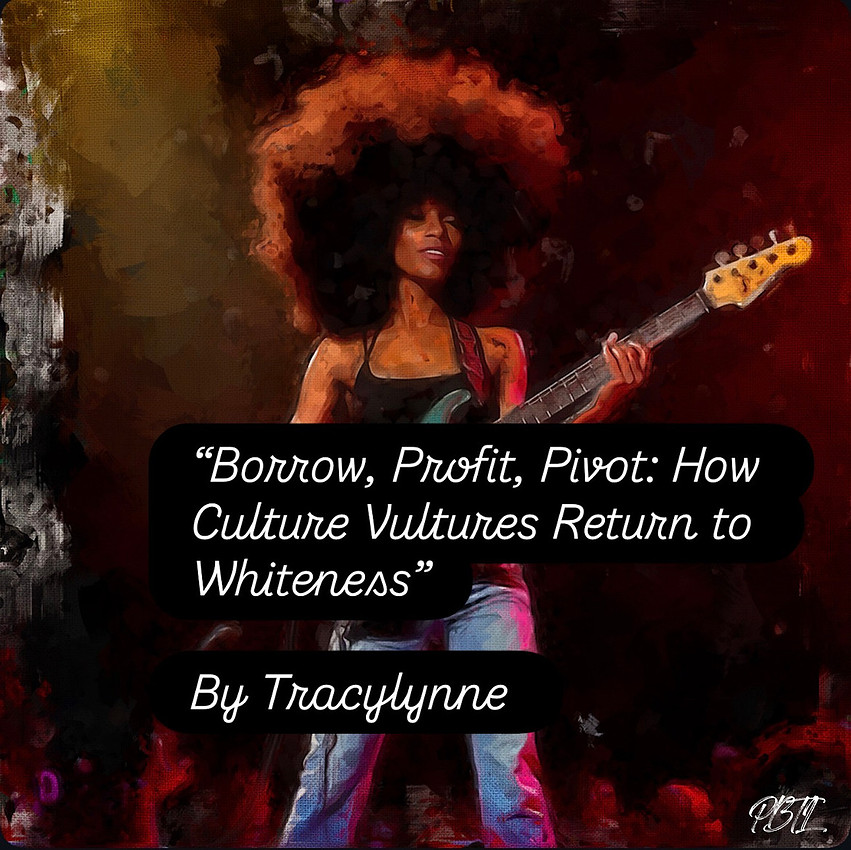

Long before Spotify, record contracts, crossover marketing, the architecture of American popular music was built on Black innovation and white intermediaries. The first commercial recordings of Black musical styles, blues, ragtime, spirituals, early jazz, were often recorded by white-owned labels that paid Black musicians little, marketed them to Black audiences, and re-sold “cleaned up” versions to white audiences. This was not incidental, it was a business model.
It is the blueprint of how non-Black artists, both white and otherwise, systematically use Black American music as a launch vehicle for their careers, only to jettison that very vessel the moment they achieve success.
They treat Black culture as a temporary resource to be mined, not a foundation to be built upon. And the most damning part? The market not only allows it, it rewards it. This is about the cold, hard mechanics of cultural capitalism and the ultimate hypocrisy of access.
The template was set not in the 21st century, but in the dawn of recorded sound. The 1920s saw the rise of "Race Records," a segregated category for music by Black artists marketed exclusively to Black audiences. Simultaneously, the industry created "Hillbilly Records" for rural white music.
The commercial potential of the blues, born from the Black experience in the Deep South, was undeniable. Enter white artists and executives who acted as cultural translators. The case of Jimmie Rodgers, the "Father of Country Music," is instructive.
Rodgers’s seminal "Blue Yodels" are direct infusions of the blues tradition into what would become country music, a borrowing that provided the emotional depth his genre previously lacked. He learned this directly from Black railroad workers, a fact often relegated to a footnote in his biography.
In the 1950s and 1960s, the pattern became obvious: a Black artist writes, records, innovates; a white artist or white-owned company repackages, markets broadly, often with small changes; the white artist gets the airtime, the tours, the awards, the legacy. Meanwhile, the originators are sometimes forgotten, underpaid, or squeezed out.
The historical precedent is as American as apple pie. The 1950s, though gave us the archetype: Elvis Presley. To deny Elvis’s talent is foolish. To ignore his strategic positioning is historically illiterate. But talent is not the point. The point is the strategic extraction. He was raised in Tupelo, Mississippi, and Memphis, Tennessee, immersed in the Black gospel of the church and the rhythm and blues of Beale Street.
His early sound, his stage presence, his raw sexuality, were direct, unabashed emulations of Black performance styles. Arthur “Big Boy” Crudup wrote “That’s All Right,” recorded in 1946. Elvis’ 1954 version launched careers and rock ‘n’ roll mythology. Crudup got scraps from what became a mainstay in popular culture.
Presley's manager, Colonel Tom Parker, understood the commercial calculus. A white man performing Black music was palatable, safe, and explosively marketable to a white mainstream not yet ready to embrace Black artists. Elvis became the king, while Crudup died in poverty. This is not a sentimental story; it is a business case study in racial arbitrage.
As B.B. King famously noted, Elvis "did a lot for the music, but he didn't do anything for the people." The data is stark. In 1956, a year after his first national hit, "Heartbreak Hotel," a Billboard survey of radio stations found that 72 percent of his airplay came from pop stations, not R&B stations. The industry machinery, terrified by the raw Blackness of the originators, found a safe, palatable white vessel.
He was marketed as a "rockabilly" artist in order to "sanitize" his influences. By the 1960s, his film career and his Las Vegas residencies represented a full pivot away from his rock and roll roots toward a mainstream, predominantly white entertainment paradigm. The man who credited Black artists like, Arthur "Big Boy" Crudup, for his sound ended his career in a sequined jumpsuit, his cultural debt long since paid off in the currency of his own stardom.
This pattern of extraction is not limited to white Americans. It is a global export. The British Invasion of the 1960s was, at its core, a repackaging of American Blues and R&B. The Beatles and The Rolling Stones were open about their debts to Chuck Berry, Muddy Waters, and Howlin' Wolf. They were translators, and their whiteness granted them a critical distance that allowed them to be seen as innovators.
But the ultimate act of translation, and theft, came from The Beach Boys. In 1963, they released "Surfing U.S.A." The melody, the chord progression, the entire sonic architecture was a direct lift from Chuck Berry's 1958 rock and roll anthem "Sweet Little Sixteen." They initially credited it to their own Brian Wilson. It was only after legal pressure that Chuck Berry received a songwriting credit. The Beach Boys took a song about Black teenage joy and rebellion and whitewashed it into a sun bleached anthem of California whiteness. They took the engine out of a Cadillac and put it in a wood paneled station wagon.
The 1980s and 1990s provide the most blatant case studies in this reversion, particularly within the hip hop sphere. The Beastie Boys began as a hardcore punk band but found massive commercial success with their 1986 album "Licensed to Ill," an album produced by Rick Rubin that was steeped in the braggadocio and sonic aesthetics of hip hop, a genre then still firmly rooted in Black and Brown urban communities.
They were celebrated for their "irreverence." But observe the trajectory. By the time of their 1989 album "Paul's Boutique," their sound had already expanded into a psychedelic collage. With 1992's "Check Your Head," they were heavily reincorporating their punk and funk roots. This artistic evolution was also a strategic migration.
They successfully transitioned from being seen as a "rap group" to being seen as "eclectic alt rock pioneers," a categorization that placed them safely within a whiter, more critically accepted canon. They kept the credibility they earned in a Black dominated space but shed the commercial limitations of being solely "rappers."
The most instructive, and perhaps most cynical, example is that of Vanilla Ice. His 1990 hit "Ice Ice Baby" is a perfect artifact of cultural appropriation. He presented himself as a street tough from Miami, a fabrication easily exposed. The sound, the style, the flow, were all direct lifts from the hip hop of the era.
When the facade crumbled, his career did not end; it transformed. He did not double down on his connection to hip hop. He retreated. He appeared in a teen comedy, "Cool as Ice," and later reinvented himself as a fixture on reality television and niche rock tours, his identity now predicated on being a 90s novelty act, completely divorced from the Black culture that birthed his one moment of fame. The reversion was total and absolute.
The 2000s brought us Eminem. He is arguably the most technically skilled MC in the commercial mainstream. His respect from the hip hop community, from Dr. Dre to Elzhi, is hard earned and real. Yet, even here, the pattern holds, albeit in a more nuanced form.
His early work, "The Slim Shady LP" and "The Marshall Mathers LP," is steeped in the horrorcore and battle rap traditions, genres with deep roots in the Black underground. His identity as a "white rapper" was his central, controversial narrative. As his career progressed, his music shifted.
The themes became less about the struggles of his Detroit upbringing and more introspective, focusing on his status as a celebrity, his family dramas, and his place in music history. He began to collaborate with artists like Ed Sheeran. This is not a critique of his artistry but an observation of his expanding cultural orbit.
He achieved the impossible: he became a global superstar through a Black art form and then gradually expanded his brand to become a universal, almost genre-less pop icon. This is a luxury that was not afforded to his Black contemporaries like Jay Z or Nas, whose Blackness and association with hip hop remained their primary, inescapable identifier in the mainstream media.
The data does not lie. A 2013 University of Chicago study on racial segregation in the music industry found that music by Black artists is consistently categorized and marketed under "urban" or genre specific labels, while music by white artists is more likely to be categorized as "mainstream" or "pop," granting it broader commercial appeal and radio airplay. This structural reality is the incentive for the reversion. It is not merely an artistic choice; it is a strategic economic decision.
The Pattern: Borrow → Breakout → Re-Center Whiteness
When a non-Black artist borrows Black musical forms and uses them to break out, they often follow a pivot strategy. Once they have status, they pivot back, not to Blackness, but to whiteness, to safety, to that “universal” packaging.
Here’s how the pivot works:
*At first, the non-Black artist leans hard into Black aesthetics: vocal inflections, traps, slang, production style, cultural references.
*They amass fans, money, brand.
*Then, they sanitize. They downplay their debt. They shift visuals or genre references toward neutral or white-coded aesthetics.
*When criticism arises for crossing genre or culture, they get the benefit of the doubt. They are “genre fluid,” “innovative.” Their risk is framed as bravery, not theft.
Meanwhile, when a Black artist tries to do a similar cross-genre move, the blowback is sharper, the scrutiny heavier, the “betrayal” accusations louder, the gatekeeping stricter.
Now, fast forward to the 21st century. The game is more sophisticated, but the rules are the same. Look at the trajectory of Miley Cyrus. She strategically shed her Disney pop persona by twerking on stage at the 2013 MTV Video Music Awards against the backdrop of Black women, using a hyper sexualized, Black coded performance style to signal her "maturity."
She leaned heavily into hip hop and R&B features on her "Bangerz" album to cement her new, edgy brand. And then, once the transformation was complete and the headlines were written, she pivoted. She abandoned the aesthetic, publicly distanced herself from the hip hop she had just exploited, and moved into a safer, more critically accepted rock and pop lane. It was a calculated, temporary rental of Black culture for a specific brand objective.
The most potent contemporary example of this hypocrisy lies in the country music scene. In early 2024, Beyonce, one of the most accomplished artists in history, released a country song, "Texas Hold 'Em." The backlash from a segment of the white audience and the industry gatekeepers was immediate and predictable.
Country radio stations refused to play it. There were ignorant, racially charged comments about her not belonging to the genre. This, despite country music's deep, foundational roots in the Black musical traditions of the American South. The hypocrisy was laid bare when, just months later, white rapper Post Malone, who built his entire career on a somber, hip hop derived sound, announced his foray into country music.
The reception was overwhelmingly positive. He was celebrated as "authentic," welcomed with open arms onto country stages and playlists. In other words: Beyoncé is accused of stepping out of place; Post Malone is celebrated for branching out. The difference isn’t genre; the difference is race. The data does not lie. A 2021 study by Dr. Jada Watson of the University of Ottawa found that between 2000 and 2020, Black women received just 0.03 percent of country radio airplay.
The message is clear: the genre is policed to keep Black artists out, while non-Black artists who have built their fame on Black music are allowed to pivot in without question.
This phenomenon even extends to non-white artists who leverage Black culture for global reach. Look at the K Pop industry. Korean pop music is a manufacturing marvel, but its primary sonic ingredients are Black American ones: hip hop beats, R&B vocals, and rap verses are foundational to the genre.
Groups like BTS and BLACKPINK explicitly modeled their styles on 1990s R&B and hip hop. They gained credibility and global market penetration by aligning themselves with the coolness and street credibility of Black music. Yet, upon achieving global superstardom, the genre often functions as a launchpad. They can, and do, expand into EDM, pure pop, and other genres, leaving the Black musical elements as a footnote in their origin story.
They are not bound to it. They used it as a stepping stone. This is the crucial distinction. A Black artist like Beyonce making a country album is seen as an invader. A non-Black artist like Post Malone or a K Pop star using hip hop is seen as an innovator, with the inherent privilege to move on when it is commercially convenient.
Even artists who seem deeply rooted in the culture follow this path. Justin Timberlake launched from the R&B harmonizing of NSYNC into a solo career that was unabashedly R&B and soul infused, working heavily with Black producers like Timbaland and Pharrell. He was the heir to the soul man throne.
But as his career matured, he seamlessly transitioned into a broader, safer pop and adult contemporary persona, eventually even dabbling in folk and Americana. His identity became elastic. He is not "Justin Timberlake, the R&B singer"; he is "Justin Timberlake, the pop icon." This elasticity is a privilege rarely extended to Black artists.
Can you imagine T.I. or Mary J. Blige deciding to pivot to folk music and being embraced by that audience with open arms? The thought is almost laughable because the industry and the audience do not allow for that level of creative mobility for the very people who created the genres.
The pattern is a brutal and efficient cycle. First, there is extraction: the non Black artist adopts the sound, style, and swagger of Black music to gain credibility and break through a crowded market. Second, there is acceptance: a white or mainstream audience, often hesitant to embrace the originators, embraces the translator.
Third, and most critically, there is the pivot: once sufficient fame and capital are acquired, the artist strategically reverts to a more mainstream, less racially coded genre, or expands their brand to become "genre fluid." They cash the check they wrote on Black culture's bank. This is the unspoken contract of musical appropriation. You can borrow the power, but you are not required to bear the burden. You can take the sound and run, leaving the creators locked in the very box you just escaped.
It is the oldest hustle in the American playbook, and it is a lesson learned not in the conservatory, but in the school of hard knocks where the tests are unfair and the grades are permanent.
If you enjoy my work and want to support more of it, you can buy me a coffee: Buy Tracylynne a Coffee