Most Educated, Least Protected: The Paradox of the Black Woman Professional

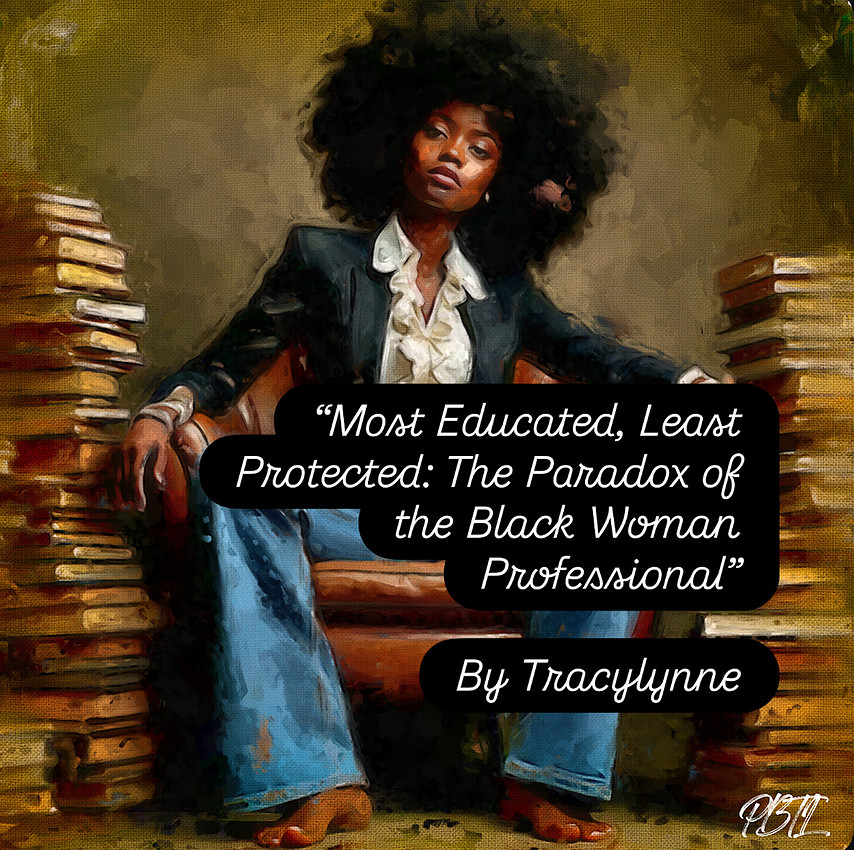

For generations, Black women have been lauded, and rightfully so, for their unwavering commitment to education. We've often heard the refrain, "Black women are the most educated group in America." And the statistics, in many ways, bear this out. Black women consistently earn a disproportionate share of bachelor's, master's, and doctoral degrees awarded to Black students.
According to the American Association of University Women (AAUW), Black women earn 64.1% of all bachelor's degrees, 71.5% of master's degrees, and 65.9% of doctoral, medical, and dental degrees awarded to Black students. This academic prowess is a testament to resilience, ambition, and a deeply ingrained belief in the power of knowledge as a pathway to progress.
Yet, there's a profound, disheartening paradox that lies beneath this impressive achievement: Black women, despite being among the most educated, often find themselves among the least protected in professional spaces. Their degrees, hard-won and meticulously earned, frequently fail to shield them from systemic discrimination, wage inequality, and a pervasive lack of advancement opportunities.
The Glass Ceiling, Reinforced with Concrete
The educational achievements of Black women aren’t translating into corporate power. In the workplace, for every 100 men promoted to manager, only 58 Black women are promoted, despite similar levels of ambition and performance.
Black women hold just 1–1.4% of C‑suite roles, even as they make up approximately 7% of the U.S. population. Meanwhile, access to sponsorship and leadership visibility is scarce, only 26% report having equitable sponsorship opportunities, and nearly 60% say they’ve never had informal interactions with senior leaders.
The corporate ladder, for many Black women, isn't just a "glass ceiling", it's often a ceiling reinforced with concrete, designed to keep them from ascending. While white women are making strides in leadership roles, Black women remain significantly underrepresented.
A recent McKinsey Women in the Workplace Report revealed that Black women hold just 7% of C-suite positions, a modest 4% rise since 2017. More alarmingly, their promotion rates in the past year have regressed to 2020 levels.
This isn't due to a lack of qualification. Studies consistently show that Black women are often overqualified for the roles they occupy. Amari Jefferson, a recent college graduate, articulated this frustration: “Even being one of the more educated people at my job, I am still being looked down upon and not taken seriously.”
Keone Evans, an entrepreneur, echoed this sentiment, stating, “As a Black person in this country, you have to work twice, sometimes three times as hard as our white counterparts. And being Black women, we're overlooked nine out of 10 times for leadership positions.”
The Wage Gap: A Persistent Chasm
Despite earning more degrees than any other group comprising 64% of all bachelor’s degrees, 71.5% of master’s degrees, and 65.9% of doctoral and professional degrees among Black students, Black women continue to be economically undervalued.
- Graduates are often left with an average student loan debt of $30,000–$37,000, significantly higher than their peers, yet they earn just 62% of what white men make, even with equivalent credentials. Their fields of study, often health administration, social work, and education, are important yet chronically underpaid.
Education is supposed to be the great equalizer, yet for Black women, it often doesn't translate into equitable pay. The wage gap is a gaping wound that refuses to heal. For every $1 a white man earns, Black women are paid only $0.60, and Black single mothers a dismal $0.56.
This isn't just a matter of different job choices; even with a graduate degree, Black women face a significant wage penalty. A Black woman with a bachelor's degree typically earns less than a white, non-Hispanic man with some college but no degree.
This "lower return on their educational investment" is a direct consequence of occupational segregation and systemic undervaluing of Black women's labor. They are overrepresented in essential, yet underpaid, jobs like childcare workers and social workers, and locked out of higher-paying fields like software development and law.
Misguided Feedback, Lower Pay
Black women are nearly nine times more likely to receive vague, non-actionable feedback, comments like “you’re professional” or “you’re an overachiever”, instead of specific guidance for growth. That kind of unclear feedback translates into fewer opportunities, slower promotion, and stagnant wages, Black women earn a median of $43,000 annually, compared to $83,000 for Asian men.
In addition, workplace microaggressions are frequent and destructive. Black women are 2.5–3 times more likely than white women to have their competence questioned or expressed surprise at their abilities.
More than one in four Black women report being singled out for their performance and frequently battle the stereotype that they are “angry,” leading to harsher performance evaluations and fewer opportunities.
Microaggressions and the "Black Woman's Burden"
Beyond the tangible economic disparities, Black women professionals endure a relentless barrage of microaggressions, subtle, often unintentional, expressions of prejudice that chip away at their sense of belonging and competence.
Comments like "You're so articulate" are meant as compliments but underscore an implicit bias that Black women's intelligence is an anomaly.
They are three to four times more likely than white women to experience disrespectful and "othering" comments and behavior. This constant need to navigate societal and workplace expectations, often referred to as the "Black woman's burden," takes a profound toll.
Consider the experience of a Black woman senior manager who recounted, "It's frustrating to hear those comments, to have your decisions questioned, to be perceived as the angry Black woman."
This perception, rooted in harmful stereotypes, forces Black women to police their emotions and expressions in ways their white counterparts rarely have to.
The Invisible Labor and its Mental Toll
Black women are also disproportionately shouldering the burden of diversity and inclusion work within their organizations, often without formal recognition or compensation. They are more likely to speak out against bias and discrimination, and more likely to face retaliation for doing so. This "invisible labor" adds to their already heavy load, contributing to what some researchers call "racial battle fatigue."
The mental health impact is undeniable. The constant stress of navigating racist and sexist environments can manifest in increased anxiety, depression, and even physical symptoms like high blood pressure and insomnia.
Dr. Vernee Butterfield, who focused on cultural competence in her PhD, likely experienced this "racial battle fatigue" from consistent exposure to racism, which can lead to burnout and severe mental distress.
"Only" in the Room and Under Constant Watch
More than 54% of Black women report being the only Black person, or one of only a few in their workplace. This “Only” status carries an intensified layer of scrutiny and pressure; one misstep can be modeled on an entire race.
These dynamics are even more prominent in education and academia. Black women faculty are tiny minorities, accounts hover around 2% of full-time faculty, and often face hostile environments, isolation, and invalidation of authority from both students and peers.
Black Women Are Still Leading—Just Not Rewarded. Consider the stories:
Regina Lawless, a former Instagram diversity director, was part of the 1.4% of Black women holding C‑suite roles before launching her own advocacy network amid workplace resistance. Actress and political figure Diane Abbott (UK) exemplifies the "glass cliff" phenomenon, Black women are given roles during crisis or scrutiny, then punished disproportionately harshly when expected to succeed.
Organizational leader Minda Harts co-founded The Memo after experiencing microaggressions and invisibility in her early career; her book became a New York Times bestseller and a pioneering resource for career advancement of women of color. Despite being the most educated, Black women are consistently least protected.
Why it Matters
Education, alone, can’t dismantle workplace bias. Institutional structures, cultural stereotypes, and wage gaps persist even in the face of qualifications.
Without sponsorship and visibility, brilliance goes unrewarded. Representation, alone, without inclusion is hollow.
Self-report data shows 90% of women of color in management feel systemic barriers limit their advancement, even when they’re overqualified
Bias in appearance, like policing natural hair or emotional expression, still affects evaluations of professionalism and career viabilit.
Beyond the Statistics: Real Lives, Real Struggles
These aren't just abstract numbers; they represent the lived realities of countless Black women. They are the doctors whose expertise is questioned, the lawyers whose opinions are dismissed, the executives who are passed over for promotions they've earned.
They are women like my aunt, a brilliant engineer who, despite her groundbreaking work, consistently found herself mentoring younger, less experienced white male colleagues who were then promoted ahead of her.
Breaking the Paradox
The paradox of the "most educated, least protected" Black woman professional is a stark reminder that systemic change is not just about opening doors, but about dismantling the structures that prevent true equity. It requires:
* Pay transparency and equity audits: Mandating transparent pay scales and regular audits to identify and rectify wage disparities.
* Dismantling biased hiring and promotion practices: Moving beyond "cultural fit" to objective, merit-based systems that value diverse experiences and qualifications.
* Meaningful mentorship and sponsorship: Creating intentional programs that connect Black women with senior leaders and actively champion their advancement.
* Addressing microaggressions and creating inclusive cultures: Fostering environments where bias is called out, and Black women feel psychologically safe to be their authentic selves.
* Valuing emotional labor and DEI efforts: Recognizing and compensating Black women for the often unacknowledged work they do to foster inclusion. Black women have consistently shown their brilliance, their resilience, and their unwavering commitment to excellence. It is time for our professional spaces to reflect that value, to move beyond simply acknowledging their education and actively protect their potential, their well-being, and their rightful place at the highest levels of leadership. The cost of inaction is not just individual loss, but a collective detriment to innovation, progress, and a truly equitable society.
What Companies Should Do
Set intersectional promotion targets, fewer than 7% of firms currently do so.
Provide actionable feedback tailored to growth.
Build sponsorship programs specific to Black women and marginalized groups.
Acknowledge cultural trauma and create safe spaces in crisis times.
Conclusion: From Degrees to Dignity
Black women rise, earning degrees at record rates, breaking cultural ceilings, and leading movements. Yet the same systems that elevate them academically too often fail to protect them professionally. They remain underpaid, overlooked, over-scrutinized, and required to prove themselves at every rung.
The paradox is clear: Most educated, least protected. Turning that narrative around requires more than celebration. It demands accountability. Representation. Advocacy. And full inclusion.
Because in the end, degrees alone don’t protect; systems, culture, and justice do.
If you enjoy my work and want to support more of it, you can buy me a coffee: Buy Tracylynne a Coffee