Crowning Resistance: The Historical Policing of Black Women’s Beauty

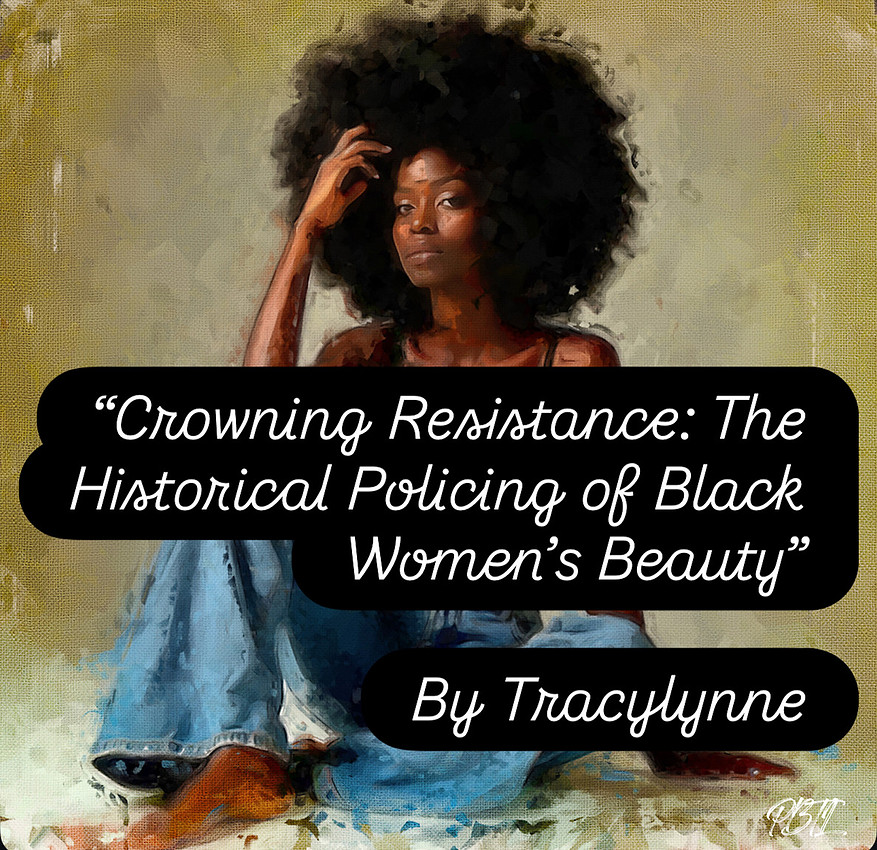

There is no gentle way to present the truth: the policing of Black women’s beauty is not a new phenomenon, it is foundational to the American project. From the plantations to the boardrooms, from the auction blocks to social media, Black women’s beauty has never been benign. It has been legislated, litigated, surveilled, stolen, and repackaged.
It has been criminalized while simultaneously commodified. Black women’s beauty, rooted in culture, defiant in spirit, and radiant in complexity, has long been a threat to the aesthetic order of white supremacy.
This is not vanity. This is warfare. The brazen fear of Black beauty, unmistakable, defiant, self-celebrating, has meant that both law and society have conspired to stifle and shame it, weaponizing aesthetics as a form of control.
Throughout history, tightly woven into colonial rule, were measures designed to subjugate Black women’s bodies, and with it, their beauty. The infamous 1786 Tignon Laws in Louisiana stand as a blatant early example. Spanish colonial authorities, obsessed with maintaining color hierarchies and anxious about the allure of free.
Black women, decreed that these women must cover their hair with tignons, or headwraps, making them visually indistinguishable from the enslaved. These laws were explicit: Black women’s expressions of beauty, be it a tightly coiled curl, a brilliant jewel, or a head held high, were threatening to the order of white privilege, warranting legal intervention.
But Black women did not cower. They transformed the tignon, a symbol of shame, into art. Instead of hiding, they adorned their headwraps in vibrant colors, ornaments, and feathers, announcing their presence with even greater boldness and creativity. This act of subversive fashion was more than resilience, it was rebellion:women in New Orleans and beyond weaponized beauty as protest, reclaiming and politicizing the very sites of their policing.
Slavery and the centuries that followed amplified this policing. Enslaved women who worked in the house were forced to mimic the hairstyles of their enslavers, straightening their hair or wearing wigs, while those in the fields were ordered to cover their natural hair with scarves, erasing African pride and enforcing Eurocentric standards. Hair was not just styled, it was forcibly cropped or shaved, wielded as punishment, a recurring humiliation and erasure of self.
Jim Crow America was no less vicious. The rise of “separate but equal” nonsense saw the targeting of every marker of Blackness deemed “unprofessional” or “loud.” Federal courts, for decades, sided with employers who fired or denied jobs to Black women daring to wear braids, twists, cornrows or locs, hiding behind “race-neutral” grooming policies that barely masked their racist intent.
The infamous 2016 EEOC v. Catastrophe Management Solutions case epitomized this: Black women, told to cut their locs or be denied employment, were essentially told that Blackness, in its natural manifestation, was unfit for the workplace.
The policing continues in schools, Black girls sent home or disciplined for showing up as themselves, their braids, their afros, their beads deemed distractions. Lip gloss becomes armor, hairstyles acts of survival and resistance. Only recently, through the tireless advocacy culminating in the CROWN Act, has legislation been introduced to explicitly protect Black hair from such discrimination.
Yet, let’s not be so naive as to imagine the old regime is finished. Laws can change, but dominant standards often persist, refusing to relinquish their chokehold on who and what is considered beautiful, professional, acceptable.
To write about the policing of Black women’s beauty is to confront a history that is ongoing. From the auction block to the boardroom, from the plantation fields to the fashion runway, Black women’s bodies have been, and too often still are, battlegrounds for the anxieties of white supremacy and patriarchy.
But make no mistake, each attempt at control has also bred new revolutions. Black women’s beauty is not and has never been static. It is reinvention, it is power, it is protest. That is the legacy, unapologetic, indomitable, and unbroken.
If you enjoy my work and want to support more of it, you can buy me a coffee: Buy Tracylynne a Coffee