The Uncredited Architects: The Irrefutable World Influence of Black Culture

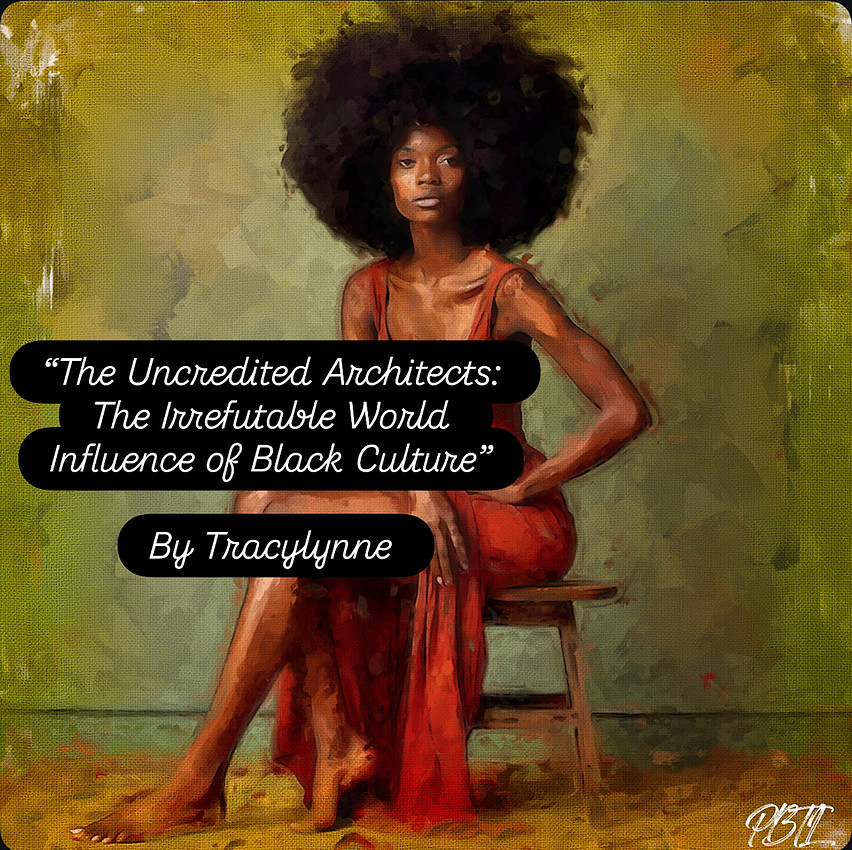

We are not here to deal in feelings or vague notions of influence. We are here to deal in cold, hard, often uncredited data and events. The central, irrefutable thesis is this: Black American culture has been, and remains, the primary engine of global cultural innovation, setting trends that the world follows, often without paying the original creators their due.
This is not about appropriation. That conversation, while valid, often misses the larger, more powerful point: foundational creation. We are talking about the source code. The blueprint. Before something can be appropriated, it must first be invented. And that is where the story begins.
There is a truth that makes many uncomfortable, but it must be said without hesitation: Black culture has always been the trendsetter, the trailblazer, and the source. What the world calls “cool,” “edgy,” or “new” usually started in Black communities long before it reached the mainstream.
This is not opinion; it is historical fact backed by centuries of evidence, from music and fashion to language and art. The tragedy is not that we create; it is that we are consistently imitated, exploited, and erased.
We can start with the very sound of the 20th and 21st centuries: music. Every major American musical genre of the last century is a Black American innovation. This is not up for debate. It is historical record. Enslaved Africans brought to the Americas carried their traditions, rhythms, dances, and oral histories with them.
These traditions were not destroyed by slavery; they adapted and became something new. The call-and-response style of African music shaped the foundation of gospel, blues, jazz, and eventually hip hop. The banjo, often associated with country music, has direct roots in West African string instruments like the akonting.
By the late 19th and early 20th centuries, ragtime and jazz emerged from Black neighborhoods in New Orleans, Chicago, and Harlem. White audiences eventually embraced these sounds, but Black musicians like Scott Joplin, Jelly Roll Morton, and Duke Ellington were the architects.
Data from the Library of Congress notes that by 1920, jazz had already become one of America’s most exported cultural products, even as Black artists were banned from many venues.
Every major American music genre has Black roots. Blues evolved into rock and roll, yet Elvis Presley was crowned “the King” while Chuck Berry and Little Richard were sidelined. Gospel harmonies shaped soul music, which laid the groundwork for R&B and hip hop.
Hip hop itself is the most glaring example of cultural dominance. Born in the Bronx in the 1970s with pioneers like DJ Kool Herc and Grandmaster Flash, hip hop is now a multibillion-dollar industry. According to the Recording Industry Association of America (RIAA), hip hop surpassed rock as the most consumed music genre in the United States in 2017.
Yet Black artists still face disproportionate pay gaps, and the industry profits most from corporate structures not owned by the creators.
· The Blues: Born from the field hollers and spirituals of the post-Reconstruction South, documented by ethnomusicologists like Alan Lomax, the blues is the bedrock. It is a musical system and a feeling that directly gave birth to...
· Jazz: Originating in the Black communities of New Orleans in the late 19th and early 20th centuries, jazz was the first true American art form, a complex and sophisticated innovation that took the world by storm.
· Rock and Roll: The term itself was coined by a Black Cleveland disc jockey, Alan Freed. The sound was a direct evolution of rhythm and blues, pioneered by Black artists like Sister Rosetta Tharpe, Chuck Berry, and Little Richard. Their sound was repackaged and sold to a white mainstream audience, but the architects are clear.
· Hip Hop: Born from the block parties of the South Bronx in the 1970s, a creation of Black and Latino youth. It is now the most consumed music genre in the United States, according to Nielsen Music's 2017 report, and a dominant global cultural and economic force.
The data on influence is staggering. A 2021 study from the Black Music Action Coalition highlighted that while Black artists drive the overwhelming majority of streaming and chart success in hip hop and R&B, they remain significantly underrepresented in executive and ownership roles within the music industry. This is the pattern: immense cultural creation, followed by systemic exploitation.
This influence extends far beyond the music itself and into the vernacular. Language itself is shaped in the urban crucible. Phrases that originate in Black communities consistently enter the global lexicon.
Consider the journey of words and phrases like "cooked," "crash out," "catching strays," "dragged," "period," and "bus down." What begins as specific, nuanced slang within a community is picked up, stripped of its context, and becomes mainstream internet speak, often without attribution to its origin.
Black vernacular has shaped the English language in the United States more than people care to admit. Words and phrases that dominate pop culture today, "dafuq", fit check, chat, ate and left no crumbs, originated in Black communities.
African American Vernacular English, or AAVE, is a recognized dialect with its own grammar rules. Yet, it is often disrespected as “broken English” until non-Black people use it, at which point it becomes “trendy.”
Historian Geneva Smitherman documented in Talkin and Testifyin that Black speech patterns were central to American English evolution throughout the 20th century. Today, platforms like TikTok amplify slang from young Black creators, only to see those creators ignored while white influencers gain millions of views and brand deals by parroting the language.
The world of sports is another clear ledger of innovation. Basketball, a sport with a majority-Black player base in the NBA, is a prime example. The style of play, the swagger, the trash talk, the sneaker culture that has become a multi-billion dollar global industry, it all flows from the Black cultural aesthetic.
Michael Jordan did not just play basketball; he became a global icon whose Air Jordan brand generated over $5 billion in revenue for Nike in 2022 alone, according to Forbes, proving the immense economic power of this cultural influence.
Even in the digital realm, the blueprint is evident. Black users have consistently been early adopters and innovators on social media platforms. Before "influencer" was a job title, Black bloggers and users on platforms like MySpace and early Twitter were setting the trends for fashion, humor, and online engagement.
The rise of Vine and later TikTok was heavily propelled by Black creators who developed entire comedic formats, dances, and challenges that were then mimicked by millions.
The "Renegade" dance, which catapulted Charli D'Amelio to fame on TikTok, was created by a Black teenager, Jalaiah Harmon, who was initially completely uncredited. In 2021, Black TikTok creators launched a “strike,” refusing to create new dances for Megan Thee Stallion’s “Thot Sh*t.” The result? White influencers were left scrambling, exposing how dependent the platform is on Black creativity.
This pattern is a digital-age echo of a very old story.
Economically, the "Black Tax" is a measurable phenomenon. A 2019 study by McKinsey & Company quantified the cultural influence of Black Americans, noting that while Black consumers are "trendsetters" and "early adopters," influencing over $500 billion in spending annually, they have historically been undervalued by brands and corporations that profit from their cues.
Black fashion has always been rooted in both creativity and necessity. During slavery, headwraps served functional purposes but also became a statement of dignity and identity. In the 18th century, Louisiana passed the Tignon Laws, which forced Black women to cover their hair to signify inferiority. Instead of shrinking, Black women turned headwraps into elaborate, colorful expressions of beauty and resistance.
Fast forward to the 20th century. The zoot suit, popularized by Black and Latino men, became a symbol of defiance during World War II. Hip hop culture in the 1980s and 90s set trends that luxury brands like Gucci and Louis Vuitton now monetize: oversized jackets, sneakers as status symbols, and gold chains.
According to a 2021 Nielsen report, Black consumers are trend leaders in fashion spending, influencing $1.5 trillion in buying power annually. That influence drives global markets, yet the originators often see little return.
The cycle is predictable. Black communities create. The mainstream ignores it until it is profitable. Non-Black individuals adopt it, dilute it, and monetize it. Black creators are then told they are “too loud,” “too urban,” or “not marketable.”
According to McKinsey & Company’s 2021 report on Black representation in the media, Black creatives contribute disproportionately to culture but are underrepresented in positions of power, holding less than 7 percent of executive roles in major media companies.
This is not about claiming that Black people have a monopoly on creativity. It is about correcting the historical record and acknowledging a demonstrable pattern of origin. It is about recognizing that the clothes you wear, the music you stream, the slang you use, and the dances you attempt are very often the products of a specific, resilient, and brilliantly creative culture that has done more with less than any other group in modern history.
What makes Black culture powerful is not just its innovation but its resilience. Creativity has always been a survival mechanism. Spirituals carried coded messages for escape routes. Jazz improvised beauty in the middle of segregation. Hip hop gave voice to systemic neglect. Each cultural form is both art and testimony.
The fact is, American culture is Black culture. Strip away the Black contributions and what remains is hollow. From music festivals to fashion houses, from viral internet memes to billion-dollar ad campaigns, the DNA traces back to Black imagination.
The evidence is in the archives. It is in the sales data. It is in the linguistic history. It is in the footage. To be educated and unaware of this is to willfully ignore the facts. Black culture is not a trend; it is the trendsetter. It always has been. And the data backs it up.
If you enjoy my work and want to support more of it, you can buy me a coffee: Buy Tracylynne a Coffee